I have been in Japan for the past week! Of course I was interested to find out what the baking scene is like here, and I was a bit surprised to find that bakeries are perhaps more numerous than I found even in Paris. The Japanese do bake and eat a lot of bread and pastries! Much of it is Western artisan style, and although I did not sample any of those breads, I must say that, if appearance is any indication, these bakers really give the Europeans and Americans a run for their money. In fact, the Japanese team won the Coupe du Monde de la Boulangerie, a triennial international artisan baking competition, in 2002 (they came in third, behind the USA and France, in 2005).
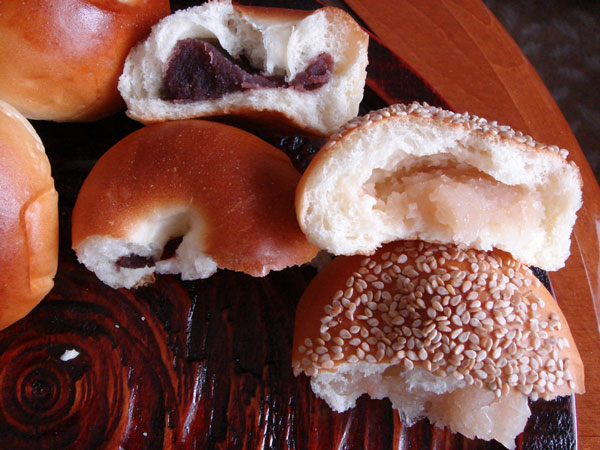
But I wanted to know if there was a bread that is distinctly Japanese, and a Japanese friend directed me to Kimuraya in the Ginza district. Established in 1869, this is one of the oldest and most well-known bakeries in Tokyo, and its founder is responsible for introducing their signature anpan, a uniquely Japanese bread. These small buns bear a resemblance to miniature hamburger buns or bagels but are soft, a little sweet, and filled with sweet red, white, or green bean paste. The filling may also include a little pickle, sesame paste, or other ingredients. The dough is made with the same yeast used to ferment sake.
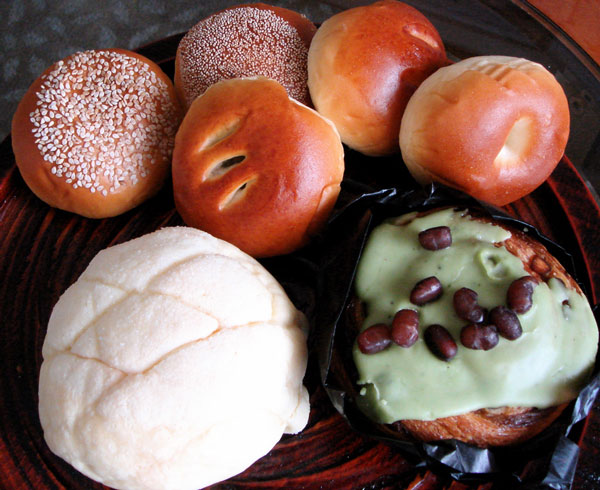
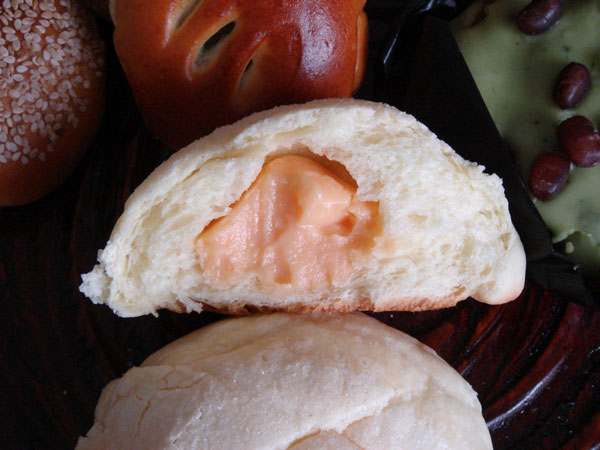
The photo above shows my take from Kimuraya: five anpan, a Danish-like pastry with green tea icing and whole beans inside and on top, and melon pan, another type of Japanese bread seen in almost every bakery. Melon pan, so named for its appearance rather than its flavor, is another sweet, soft bun crusted with cookie dough, and may include some type of filling. This one was filled with a mango custard, and quite tasty.
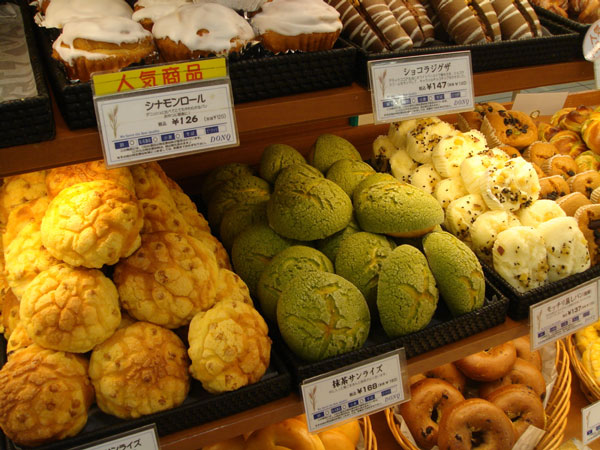
In the basement of each and every department store are (usually two floors of) amazing food halls containing every imaginable type of edible delight: not only baked goods but produce, meats, ready-to-eat foods, packaged gift foods, and more, all beautifully displayed according to the exquisite Japanese aesthetic. Two types of melon pan are seen in this photo, taken in one such food hall. I sampled the green one, which was filled with sweet bean paste and covered with tea-flavored cookie dough. Very delicious, if a little crumbly and messy to eat.
In a few hours I leave Japan… for now. I will return, to soak up more of this unique culture and perhaps learn how to bake some of these wonderful breads.
Hello Susan,
I think a lot Asian countries was greatly influenced by Japan culture especially in term of food. Form what I partly grew up as well as traveling; a lot of their breads contain egg, sugar, milk and so on, quite different from here; they also use some cake flour in their bread. Here is the great link (In Japanese): http://www001.upp.so-net.ne.jp/e-pan/recipe/reccipe.htm
I do have some recipe book in Chinese as well as Japanese, if you need anything, do let me know. Have a great trip.
PS: Do you visit their baking store, they do have a huge selection.
Kim,
I wish I could read Japanese (maybe someday)! I did visit Kimuraya’s store; they do have quite a selection of anpan. The store is rather small in area, and was quite crowded when I went. Since I do not speak any Japanese, I had to order by pointing. As in every Japanese establishment, the people there were exceedingly polite and patient with me.
This is fascinating. I had no idea that wheat was used for anything but noodles. I didn’t even think that wheat grew in Japan! But take a look at these excerpts from asiakan.org:
I wonder if there is a Dutch or Portuguese bread like anpan…
-Elizabeth
The word for bread used in Japan is ‘pan’ taken from the portuguese ‘pao’ from when the Portuguese came to Japan.
I am very keen to lay my hands on the recipe for the japanese bread. Can anyone help.
I have tried many but with not much success.
Thanks
Elizabeth, I too had no idea that the Japanese were bread eaters. I found this interesting information on wheat in Japan: http://www.asiakan.org/japan/wheat_japan_intro.shtml
George, I just posted my version of melon pan here: http://www.wildyeastblog.com/2007/08/05/melon-pan/
Hi Susan,
I’m Japanese and live in Japan.
Yes, we have a lot of unique original bread here. And I want people in other country to know the Japanese bread. I’ve been thinking this since I started baking bread.
Now bread baking is quite popular in Japan. There are a lot of bread baking studios. It’s widely spreading in Japan.
And many people have own blog about bread.
I wish I could own bakery shop in America…
Chiharu, thanks for your note. Do you know of any Japanese bread blogs or other sites that have information in English? I would like to learn more about your breads but I don’t read Japansese (or speak it either).
Susan,
There is a blog which has some recipe in English. The address is below.
http://hidehide.net/bread-english.shtml
When I find others, I’ll let you know.
I’ve just come back from my vacation in Honolulu, Hawaii. It has great nature and a lot of shops, but not many bakery or nice cafe, especially @ Waikiki… (I still love Hawaii, though.)
I used to live in San Francisco. I miss there!!
Thanks for the link, Chiharu. I love Hawaii too (but never been to Honolulu!)
I would like to know about “sponge dough”
because most of japanese bread baking book they say about this but I don’t understand japanese.
Hello,
I live in Okinawa, Japan working with the bases here and have not mastered the Japanese language yet. I LOVE the Japanese breads sold in the bakeries (the sliced milk or hotel breads that have an almost stringy texture when pulled apart). I am almost an intermediate baker but have yet to find a recipe or instructions on the technique to make it. I love the link that kim posted http://www001.upp.so-net.ne.jp/e-pan/recipe/reccipe.htm but can not read it. Does anyone know if this book or the recipes have been translated to english or where I can buy really great Japanese bread cookbooks? I might pay to have someone translate a few of the recipes. That is how much I love to bake and how much I love Japanese breads. Yes, I can just go down the street to buy it, but there is so much satisfaction to be able to make a really GREAT loaf by hand. Also, when I rotate from Okinawa, I would love to be able to have great Japanese style bread wherever or whenever I want.
I use only commercial quality ingredients and King Arthur flour. Please help! If you know of any baking schools that I could go to in Okinawa while stationed here, I would love to do that also.
Thank you 🙂
Bingata, I wish I could help but I don’t know anything about Japanese cookbooks or baking schools. Consider posting your question at The Fresh Loaf.
Thank you Susan 🙂 That is a great suggestion. I am hoping Kim, who posted the link, reads Japanese and might be able to translate a few of the recipes or knows of another site that has true Japanese style Pain de Mie, hotel and their regular milk sandwich loaf recipes already translated into English. I translated one of the recipes via Google but the translation was off and the recipe made no sense at all.
I suspected that beautiful stringy texture, not crumby like most US breads, was all in the kneading and folding techniques and from the pictures posted with the recipes in Kanji, I guessed right. If I do go and have it translated I will be sure to post the english versions of the recipes. After I test it ofcourse 🙂
I will keep you posted.
hello susan,i suggest u can go to http://www.windowslivetranslator.com/
This is an old thread, but if Bingata is still around I was wondering if Giro’s bakery is still around on Okinawa? I grew up there in the 60’s (a very long time ago!) and they did American style breads and patries that were wonderful. I think they were out toward what was then called Futema housing area.
heyyaa thats nt the website i jst want to know sm of the names for the breads for my homework please ty xx 😛
HELLO ANYONE!!! Recently I was told from a Japanese Friend that there is a bread called, “SAN SHOKU PAN” or 3 flavored bread…One consisting of pan, One consisting of custard, and one consisting of chocolate…Does anyone know of this bread or have a recipe they would like to share? Thanks!!!
SAN SHOKU PAN?
I am having my holidays in Tokyo . IS there any place that I can learn breadmaking ? And the class schedules too. Or any one-to-one teaching . I have only 1 week in Tokyo.
Thanks
I too have been keenly interested in Japanese/Asian style breads. I particularly am enjoying the Hokkaido style milk breads and Chinese Custard bread. Both are similar, but use individual approaches to starting the bread. Each uses a “paste” and the Chinese paste contains an egg along with the other ingredients. I have posted the Japanese style bread recipe and instructions on my website http://loavesandladles.com. I am going to post the Chinese Custard=style loaf recipe there as well. I need to make more today so I can get more images. The technique and end result are absolutely fabulous. I hope it helps. What caused me to land here… I am looking for a Japanese bread pan for Hokkaido bread. I can, in a pinch, use an american sized loaf pan, but it does squeeze my bread a bit too much during the second rise, so I’d love to find something bigger.
Oooops, I gave the wrong URL for my blog.. It’s fairly new and I haven’t been actively recruiting anyone to it.. it’s really for my own personal use, but anyone is welcome to join.
http://loavesandladles.blogspot.com
Kim,
Im really interest in Japanese Pastry and Bakery but still more on Bakery. Sorry for trouble u, but may recommend me some good Japanese Bread book but in English version then i can have a better knowledge on it. Thanks
While i am in Japan, i used to go in combeny store and first i bought Japanese sweet bread. i really liked to much and i missed it too…..
Howdy, I believe your web site may bbe having nternet browser compatibility issues.
Whenever I look at your website in Safari, it looks fine but when olening
in I.E., it has some overlapping issues. I somply wanted to provide yoou with a quick heads up!
Other thawn that, great site!
Hello,
I just came across this blog now and I hope Chiharu or anyone living in Japan, the Philipines or Asia generally is still here.
I am working on setting up a bakery in Nigeria and I will like to employ a baker who’s good with bread and another cakes. But for now, bread and donuts are the major focus.