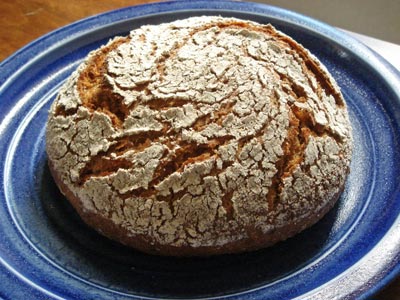
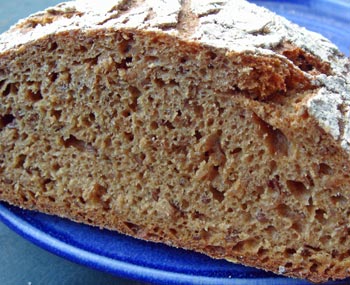
There are many things I like about this Finnish Rye. It’s dense but moist, chewy and a bit crunchy, rich in whole grain flavor but a little sweet as well. It’s very good, although not what I’d want to eat every day.
The thing I love about this bread is how an incredibly simple technique – rolling the underside of the dough in coarse flour during the last turns of the shaping, and baking with that flour-dredged underside on top – produces such a striking crackled crust. If I were ever to open a bakery (which I never will), this bread would definitely be one of the ones front and center in the window.
The combination of the dark-colored dough and light-colored flour here makes for an especially beautiful contrast, but the same technique could be used with just about any boule-shapeable dough and any coarse topping such as semolina, cornmeal, bran, or even small seeds.
Finnish Rye
(adapted from SFBI formula)
Yield: 1.1 kg (2 loaves)
Time:
- Soak soakers: at least 2 hours
- Mix final dough: 15 minutes
- First fermentation : 1 hour
- Divide, preshape, and rest: 35 minutes
- Proof: 1.75 hours
- Bake: 1 hour
Desired dough temperature: 77F
Cracked Wheat Soaker Ingredients:
- 79 g cracked wheat
- 79 g water
Flax Seed Soaker Ingredients:
- 49 g whole flax seeds
- 74 g water
Final Dough Ingredients:
- 175 g whole wheat flour
- 88 g finely ground whole rye flour
- 88 g flour
- 210 g water
- 1 g (1/3 t.) instant yeast
- 12 g (2 t.) salt
- 53 g molasses
- 193 g ripe 100% hydration sourdough starter
- All of the cracked wheat soaker
- All of the flax seed soaker
- Coarse rye or whole wheat flour for topping
Method:
- In a small bowl, mix the cracked wheat soaker ingredients until just combined. Cover the bowl and let the soaker rest at room temperature for 2 – 12 hours.
- Do the same for the flax soaker.
- Place the final dough ingredients, except the soakers and about 10% of the water, into the bowl of a stand mixer. Mix on low speed until the ingredients are incorporated, about 4 or 5 minutes. Add water as needed to give the dough a medium consistency. The dough will be very sticky at this point.
- Continue mixing on low or medium speed until the dough reaches a medium level of gluten development. This might take about 6 minutes, but will depend on your mixer.
- Add the soakers and mix in low speed until they are evenly incorporated into the dough, about 2 minutes.
- Transfer the dough to an oiled container.
- Ferment for 1 hour at warm room temperature (73F – 76F), or longer if the room is cooler. The dough should increase about 50% in volume.
- Divide the dough into two equal pieces of about 500 g each. Preshape the pieces into balls and let them rest, covered, for 30 minutes.
- Shape the dough into tight balls by rotating it (as usual) on the countertop while using the edges of your hands to tuck the edges of the dough underneath. Most of this is done on an unfloured counter to provide friction needed to get the ball tight, but do the last couple of turns in coarse rye or whole wheat flour. Do not try to pinch the bottom seam closed.
- Place the loaves seam-side-down on a board that has been dusted with the same coarse flour. Slip the board into a large plastic bag.
- Proof for about 1.5 hours at warm room temperature, or a little longer if the room is cool. The loaves should increase in volume by about 75%.
- Meanwhile, preheat the oven, with baking stone, to 440F. You will also need steam during the initial phase of baking, so prepare for this now.
- When ready to bake, turn the loaves onto the peel so that the floured side is up. Do not score the loaves.
- Once the loaves are in the oven, turn the heat down to 410F. Bake for 10 minutes with steam, and another 40 minutes or so without steam. Leave the oven door cracked open during the last 15 minutes of this time. Then turn the oven off and leave the loaves in, with the door ajar, for another 10 minutes.
- Cool on a wire rack.
I will try your recipe soon and will let you know how my bread turn out. Thanks.
That is awesome patterning on the top and a simple technique. The crumb looks beautiful. I’m intrigued that you wouldn’t eat this everyday . . . to sweet, to strong or you just like variety.
A bakery, yes, well, I’d never want a real bakery but sometimes I like the idea of a once a week bakery where I’d turn out 10 to 15 loaves! That might be fun for a while.
My, that looks good. I’m just starting to make a starter, and will come back to this recipe when it’s ready. I think it deserves to be the first bread …
Thanks for sharing
Joanna
Wondered here through Tastespotting, and your blog seems amazing!
Also, the bread looks delicious – even though traditional finnish rye around here (Finland 😉 would be a super simple combination of a sour starter and 100% rye flour, just add seasoning. The older the starter the better – they last generations if handled with care!
I have been looking for a good Sourdough (Finnish) Rye recipe. This looks delicious
Thanks
This is a beautiful loaf of bread.
As a PROFESSIONAL CHEF from Brooklyn, New York, I am totally unimpressed.
If you were that professional yup you wouldn’t brag about it. A good and professional chef stays humble ?
Don’t worry about Chiffonade, sounds like a negative creep!
Susan looks fabulous! From a professional Chef Manhattan!
After scouring your blog for bread-baking advice last week, I attempted one of my own recipes! It’s at http://sugarlaw.blogspot.com/2007/11/parmesan-wheat-bread.html
I’d love suggestions, if there’s something you think I could do better!
Beautiful bread, clear concise directions, I could eat the monitor. I will add my voice to the many…open your own joint and place this one in the window, they will come.
-David Aplin
Your work makes me want to hole up in my kitchen and just bake for a couple of weeks. I guess if I did that, I’d be able to make that wild yeast bread that is a hit or miss, right? The one where I have to catch the yeast that’s in the air? Now that would be amazing. Maybe after Christmas…
What a lovely loaf of bread that rye is. Goodness, but you are inspirational.
Beautiful bread! I love dark loaves with pates and cheese. I happen to have all the ingredients on hand for this weekend!
Kim, I hope you like it!
Tanna, maybe just a bit too sweet for everyday, for me. But then there aren’t many things I’d want to eat every day.
Joanna, good luck with your starter. I think this is a great bread to christen it.
Arho, I’m glad you jumped in here. I hadn’t known whether this would be considered a traditional Finnish bread. Thanks for the clarification!
Tammy, thanks!
Jeremy, thank you, I really appreciate your encouragement.
Sugarlaw, your bread looks wonderful, and I left a comment on your blog.
David, I think I’ll stick with my virtual window for now. Thank you for the kind words!
Kellypea, a wild yeast starter is easier than you might think. The yeast arrive on the flour, so they’re pretty much captive right away. Do give it a try!
Tartelette, I would love to know how this turns out for you if you make it. (Of course it is bound to turn out well; I don’t think you’re capable of making anything that doesn’t!)
I just wanted to say that the taste of this bread is awesome. I made one and going make a second today! Great taste.
I studied for baker and even though I work in chocolate I cannot understand why a professional chef would be not impressed.
I am impressed! This bread tastes great.
This is not a “Finnish” rye. Flax and cracked rye are not part of any Finnish rye with which I’m familiar.
It may still make a fine loaf though.
Aksel K.
Bart, glad you liked it!
Aksel, I hope I’ll get to Finland one day to taste authentic Finnish bread for myself. Thanks for clarifying that this one is not — but you’re right, it does make a very fine loaf!
Have you compared this to the similar Finnish rye in Maggie Glezer’s book? That’s a favorite of mine. Soaked flax has the consistency of egg whites, and produces an interesting moist crumb.
jkandell, I’ve not made the one in Artisan Baking but this is very similar to it. The major difference, as far as I can tell, is that it uses cracked rye instead of cracked wheat. I will try it soon.
Being Finnish, I’m plenty used to this bread, and I do agree that I’d not eat it everyday either. As a child, and to some extent still, I simply butter the bread with unsalted butter and tear off the crusts (unfortunately, I was never a fan of them).
I’ll have to bake this, as I can get this readily in shops, so we’ll have to see how my own baking measures up.
Susan, this is an amazing blog! Your shaping tutorials are the best I have seen & the breads look utterly perfect.
I have two questions;
Is it bulgur or cracked wheat in the Finnish rye? The bulgur is processed with steam and will be a lot softer after soaking than cracked wheat.
Are the classes at the San Francisco Baking Institute suitable for home bakers? I have often hankered after some guidance but would hate to be the only amateur in a professional class.
Patsy, you are very kind! The recipe calls for cracked wheat, which I always though was the same as bulgur. Thanks for setting me straight and I removed the “(bulgur)” from the recipe. The courses I’ve taken at SFBI have been on average about 50% home bakers (including me) so I definitely don’t think you’d be the only amateur and they are very welcoming to all.
I have been searching the internet for a Finnish Sourdough Rye Bread recipe without using other flours and without using instant (or any) yeast in the final recipe. My daughter is allergic to commercial yeast and Wheat but can eat Rye, so I am attempting to make some bread she can eat. I heard from a friend that there are some good Finnish recipes for this type of bread one can make from scratch, but so far I have not come across any. Would any of you happen to know of this recipe? (I happen to live in Asia where I do not have the benefit of finding a ready-made starter anywhere.)
my finnish rye bread:
1st day
100 rye flour
100 water
^including rye starter
mix and let it rest on room temperature over night
2nd day
add:
100 rye flour
100 water
7 salt
proof breads about 2 hours
very simple 🙂
Traditional finnish country rye doesnt have any wheat flour or yeast. And rye is always whole flour since its the only type you can get in finland.
Only ingredients are rye, water and seasalt with sourdough.
I just made this bread and it is delicious (!!!) even though I managed to add too much water and the crust is a little too done, I am still very impressed.
Susan,
This is a great bread, and though Finnish, reminds me of the bread we got at the bakery where I grew up in Hungary more than anything else I’ve come across.
A question: I’ve made this a couple times, and both times the dough after fermentation is still sticky and difficult to form into boules. Is this normal? The rise is just fine at both stages, and the crust and crumb are lovely, but on the whole the loaf is rather flat. Should I simply use less water before adding the soakers?
Thanks,
CTH
With memories of watching my grandmother baking bread in her wood fired wall oven at the farm in Finland and being reminded of the aroma and the incredible taste of these round loaves fresh from the oven I was immediately taken back in time when I saw the picture of this bread loaf online.
I cannot wait to try this recipe.
Not being a baker I have a question; how does one steam bread in a conventional oven?
Any help in this regard would be appreciated.
L. Halonen: here is my post about how to achieve steam in your home oven: http://www.wildyeastblog.com/2007/07/02/steam/
In general, when you see an underlined word in one of my recipes, such as steam in step 12 above, this will link you to a post explaining more about the technique.
Hope this helps!
Finnish Rye Bread is healthy, easy to make and has no preservatives. The root can be passed down from generation to generation. Main ingredients are rye flour, salt and water. To get the hard darker crust is a skill that takes years to master.
Thank you Susan – wonderful recipe. I did however struggle with substituing Black Treacle for the molasses in your recipe. Black Tracle seems to be the only syrup readily available in the UK and from what I can work out, it’s a bit stronger than the molasses in the US. The result, whilst very nice, has a slight bitter aftertaste from what I think is too much treacle, so I’ll try again with less and report back.
I made this for the first time, actually following the recipe! It is a totally delicious bread. I might try it again with cracked rye for comparison. Thank you for this post, Susan.