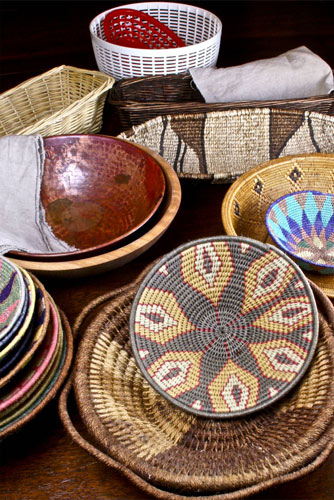
A while ago I wrote about brotforms, the German coiled cane proofing baskets that leave a spiral pattern on the crust of your loaf. What if you don’t have a brotform, or don’t want that spiral pattern? A banneton, French cousin to the brotform, is a woven wicker basket that usually has a linen fabric liner sewn into it.
A basket provides support for a proofing loaf; the linen liner reduces sticking and yields a smoother crust than an unlined basket. While I do proof most of my boules and batards in linen-lined baskets, they’re not official bannetons. Instead, I use loose pieces of natural unbleached linen that I lay inside of whatever basket or other vessel I want to use use for proofing. This works very well and has quite a few advantages over sewn-in liners:
It’s flexible. Any basket or bowl can be used; you don’t need special “proofing baskets.” I have been known to use decorative wicker or sisal baskets; the basket from my salad spinner; plastic chip baskets; and salad and mixing bowls made from wood, ceramic, plastic, or metal. Whatever size you need, you probably already have it around the house. Of course if you already have a brotform, you can lay a linen liner in that too, if you feel like it.
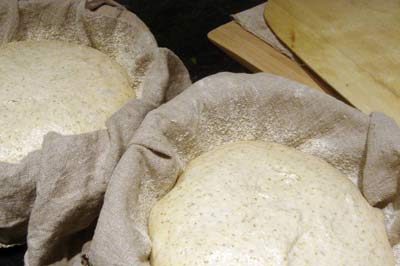
Sticking issues are reduced. Sometimes a sticky dough wants to glue itself even to floured linen. Being able to invert a loaf-and-linen unit out of the basket and onto your baking peel, and then gently coaxing the fabric away from the dough, is infinitely easier than awkwardly trying to pry a recalcitrant boule out of a basket.
The linen is easier to flour. Do you have trouble flouring the sides of your proofing baskets because the sides are too steep? Try this: lay a piece of free linen flat across the top of the basket, flour it in that horizontal position, then place the shaped loaf in and let the loaf conform the linen to the basket.
The linen is washable. Although I don’t usually wash my linens, I can do so easily if I need to. When the linen is sewn to the basket, nothing doing. (Generally I just brush away excess flour and hang the linen to dry before storing.)
It’s inexpensive. One yard of 54-inch-wide fabric makes six 18-inch squares, a good size for most uses. I couldn’t find any natural linen (you want undyed, to be food-safe) in my local fabric stores, so I ordered from fabrics-store.com, at about $15 for a yard, including shipping. (I washed it and sewed a zigzag machine stitch around the cut edges of each piece before using them.) And if for some reason you don’t have a single suitable bowl or basket lying around the house, you can get wicker baskets for a couple of bucks at most craft supply stores.
So there you have it, the frugal baker’s version of the banneton. Now go forth and proof!
Susan,
whoa are those all of your proofing basket? They are gorgeous! Thanks again for the tips, this really help a lot. I made your sweet potato bread to day, in fact I’m eating it right now. OMG, it’s so delicious…. it’s chewy, and the crust also very crusty. I actually mix the technique from sweet potato and the norwich. I proofed one of them in my brotform, I guess it was a bit too wet, so it didn’t slide nicely when I transfered it to my peel. I will use linen next time if my dough is a bit sticky. Thanks Susan, I know I can always rely on your recipes and the tips too!
Hey Elra!
How much sweet potato are u putting in the dough. I assume u cook and mash it first?
Thanks 🙂
The first photograph is gorgeous!
What a fantastic post. I don’t have a brotform and though I do think it would be really neat to have one, my baskets and mixing bowls work just swimmingly with linen draped in them. When I’m proofing really wet doughs I like to dust mine with rye flour – I feel like it’s less likely to absorb it so readily.
Try using rice flour. I found it to work so much better than rye, wheat, or spelt.
Yes! After using rice flour. Ive had no problems with sticking.
Hi there, apart from cooking, I like baking bread too, lovely to find your blog. Cheers, Janet
Now do I feel stupid…
I can’t tell you the number of times I’ve removed the folded up linens from the BANNETON AND BROTFORM pile to flour the darn things and never once did it occur to me to line them with the linens. DOH!!!!
Thank you, Susan! I’m late to the conversation, but I’ve just made my first sourdough starter, and didn’t want to heavily invest in tools until I’m sure I’ll be making more, now I may not have to spend a lot at all. I was clueless about containers I could use instead of a baneton. So I did a search, and your article popped up! I have an salad spinner, mixing bowls, lots of different woven baskets! I even have non-terry cotton hand towels! Isn’t the web amazing sometimes? If I decide to make more sourdough, I’ll just get an inexpensive long or oval breadbasket with my tea towel. Thanks, you opened a whole new horizon for me.
Nice tips… Pretty crazy what some stores charge for bannetons and proofing baskets.
I especially like the comment about stickiness. It SUCKS when that happens and using removable linen really helps.
Thanks for this post – I’ve been wondering how important the form was to structure, and now you’ve made me see that some experimenting with different types of baskets is fine. Whew!
I’d love to know if unbleached muslin could be used in place of linen . . .
I don’t even actually own an authentic banneton because they are so darn expensive and I love my homemade ones for all the reasons you have listed. I go to the equivalent of the Sally Ann and buy all the nice bread baskets in all different shapes for around 50 cents. I even found the linen napkins there that are the perfect size for doing small couches or fitting the bannetons. Who needs preofessional equipment? Your baskets are beautiful!
Great post, Susan! I love the tip about putting the dough on the horizontally floured linen and let its weight lower it gently into the basket.
Thanks all, I’m glad I’m not the only one doing proofing baskets by the seat of my pants.
Sandy, yes, muslin is a good stand-in for linen, as are cotton napkins and tea towels. Just make sure it’s well-floured as I think cotton might have a bit more tendency to stick than linen (or I might just be making that up).
Great ideas. I spotted a lettuce spinner among the “bannetons”! I love the idea of multi tasking kitchen items. Great use of time and money and space!
Thanks so much for the fabulous idea for the proofing baskets. I had started with an african basket , similiar to colourful one you have in the photo but it stuck a bit . The linen will be a great help. I’m off tomorrow to purchase it.
Cheers
Mj
I am only a few years late in this discussion but does it make a difference whether the fabric is flax linen or cotton linen (unbleached cotton canvas)?
Hi James, just a note, Linen is always made from flax, cotton is cotton. There is no such thing as linen made from cotton unless of course it is a blended weave. I think you maybe confused with the fact that bed ‘linen’ is made from cotton. Hope that helps Maria
Hi Susan,
I have been reading several of your post in the last few weeks. I successfully grew my sourdough starter last week and am going to make my first loaf of bread tomorrow and was trying to find out how I can proof my bread without a proofing basket that called for in every recipe I read. I waited one week to make my bread and I don’t want to wait until I by a proofing to make my bread. I can’t wait any longer…hehehe. I am glad I find this. I have many bowl, but I don’t have linen so I am going to try using a cotton towel and see if it work out. I love reading your post. I even read about the water, stream, gluten windowpane post. Thank you so much for sharing all that great information. I will be back for more reading. Oh, I am also going to try your Sourdough English Muffin recipe tomorrow; I have a LOT or sourdough starter since I don’t have the heart to throw away any when I feed.
Hi Susan, today I am making my second baking of “My New Favorite Sourdough”. I let my loaves proof in the pan I bake them on, as I don’t have a stone, so there is no transferring of the proofed loaves. My first loaf turned out quite nicely, actually my best loaf so far in my short sourdough baking history. Could you possibly explain how detrimental this technique is compared to using a form and then transferring to the same pan I already use to bake on. Also, doesn’t the dough go a little flat when you transfer? I did this in one of my earlier bakings and the dough lost volume and never regained it during the baking, so I’ve been hesitant to do that method. Thanks, and I hope to hear from you. Sorry for the silly newbie questions.
Great information on the proofing baskets, thank you.
What a lovely fraternity there is among ‘bakers’. Always willing to share tips and ideas. Mine is to use a natural wooden bowl to prove- which you never wash but clean with flour and put away covered for next time. I learned this in Finland where the yeasts in the wood provide a wonderful taste to the bread. Mine had been in use for several years and is always clean and ready for the next mix. My friends always know where the bread has been proved and they say the taste is wonderful- ‘real bread’.
Is it the rustic or the open weave linen from fabrics-store.com, that works best for lining baskets?
Ah, finally a thread about how to use proofing baskets 🙂 I am constantly having a fight with them because the dough just keeps sticking to them. More flour? Less water in my dough? I bought my proofing baskets on Amazon (click here for a list) but I have a feeling that the quality of these baskets are not the same… Does anybody have any tips for me how to use them without the dough sticking? I don’t line them. I can use my fingers as but the dough deflates quickly that way…
Unquestionably imagine that which you said. Your favorite
justification seemed to be on the net the simplest thing to understand of.
I say to you, I certainly get irked at the same time as people consider worries that they just don’t recognize about.
You controlled to hit the nail upon the top as neatly as outlined
out the whole thing without having side-effects , folks could take a signal.
Will likely be back to get more. Thank you
thanks for sharing your experiences. i struggled to get the lined baskets for those reasons and now will go to my favorite fabric store to buy my own linen and Michael’s for a wicker basket. now if i can just get the recipe down! thanks
Susan what’s your take on covering dough rising and proofing? Should a cover be airtight e.g. plastic bag or bowlcover? Or is it enough just to use a tea towel to keep things (flies etc) from getting in?
Thanks for your down-to-earth style.
Sun-cerely, Sunny
I cover to keep air out, so a crust doesn’t form on the surface of the dough.
Thanks for the tips Susan. I found this post when I’m searching for an oval shape banneton. I actually don’t want the pattern on my breads, but I don’t know what type of linen to use as covers. I’ve read that the linen should be lint-free. Is cotton ok to use? I have some clean white towels laying around, probably have been bleached. Is that not good?
I’ve been using cotton kitchen towels and brown rice flour, which have both worked well.