If you’re moving across the country and want to take your sourdough starter with you, or want to mail some to a friend, or want to save a backup of a particularly well-loved starter as insurance against accidental loss, drying your starter can be the way to go.
Drying a liquid starter is simple and fast, and reviving it to baking strength takes less time, and is easier, than starting a new one from scratch.
Before drying your starter, make sure it is strong and vibrant. If you normally refrigerate it, take it out and feed it for a few days, as you would before using it in a dough.
When it is good and strong, feed it a final time, then ferment it for about half the time you would normally go until the next feeding. You want the yeast to have something left to feed on while they are falling asleep.
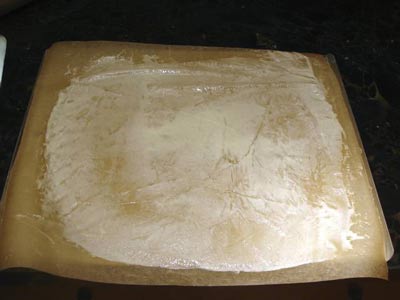
Then, using an offset spatula, spread a thin layer of starter on a piece of parchment, put it somewhere where it will be free from flying debris, and wait for it to dry completely. This will take approximately overnight, but the exact time will vary according to the hydration of your starter, how thickly your smear it, and the temperature and humidity in your house. Make sure it is completely bone dry, or you run the risk of mold.
Here’s how mine looked just after spreading it out to dry:
Have you noticed that most of my recipes list ingredients in grams? I often receive email from people asking if I would convert the grams into ounces, or into volume measurements. I’m sorry I cannot do this on request, but here are some tips that may help you, if you want to do the converting yourself.
I strongly recommend weighing ingredients, especially flour. The reasons for this are explained in my post about scales and weighing. Many scales can switch between avoirdupois (ounces/pounds; the US system) and metric (grams/kilograms; the sane system) units.
If you do not have a scale, or your scale does not have metric units, you will have to do some math. (Remember when you rolled your eyes in 5th-grade math class and complained that you couldn’t imagine when you would ever need this stuff in real life? Now would be a good time.)
I have seen different methods for shaping ciabatta; the method I use is really more cutting than shaping.
In contrast with most other doughs, which are assertively de-gassed during shaping, ciabatta wants to be handled very gently to maintain all those lovely bubbles that have developed during fermentation.
Folding is a powerful technique for strengthening a dough. Wet doughs such as ciabatta can particularly benefit from folding, but can also be challenging to fold. The key is using plenty of flour on the counter (go ahead, make a mess!); excess flour should be brushed away so you don’t get streaks of unincorporated flour in your loaves.
The folds of a couche (a piece of stiff linen) are ideal for cradling and supporting proofing baguettes and batards. But how do you transfer the proofed loaves onto a peel so you can get them into the oven?
Flipping board to the rescue. A flipping board is nothing more than a narrow piece of wood onto which the loaf is gently rolled off the couche, and from which the loaf is then either rolled or slid onto the peel.
In the video below, I use a 27 x 4-inch board to transfer baguettes onto a piece of parchment on my plywood board “peel.” (I will slide the parchment, loaded with three baguettes, onto the baking stone in the oven.)
These baguettes have been proofing seam-side-down in the couche, and I want them to wind up seam-side-down on the parchment. To do this, I lift the edge of the couche to roll the baguette onto the flipping board, so it’s now seam-side-up. Then I roll the baguette off the edge of the flipping board onto the parchment, so it’s seam-side-down again.
A while ago I wrote about brotforms, the German coiled cane proofing baskets that leave a spiral pattern on the crust of your loaf. What if you don’t have a brotform, or don’t want that spiral pattern? A banneton, French cousin to the brotform, is a woven wicker basket that usually has a linen fabric liner sewn into it.
A basket provides support for a proofing loaf; the linen liner reduces sticking and yields a smoother crust than an unlined basket. While I do proof most of my boules and batards in linen-lined baskets, they’re not official bannetons. Instead, I use loose pieces of natural unbleached linen that I lay inside of whatever basket or other vessel I want to use use for proofing. This works very well and has quite a few advantages over sewn-in liners:
It’s flexible. Any basket or bowl can be used; you don’t need special “proofing baskets.” I have been known to use decorative wicker or sisal baskets; the basket from my salad spinner; plastic chip baskets; and salad and mixing bowls made from wood, ceramic, plastic, or metal. Whatever size you need, you probably already have it around the house. Of course if you already have a brotform, you can lay a linen liner in that too, if you feel like it.