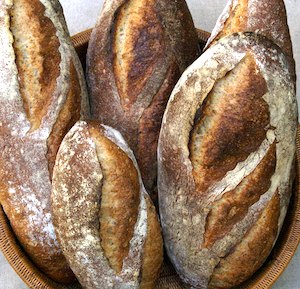
Video: Shaping a Pointy Batard

This video demonstrates my method for shaping a pointy batard. It assumes the dough has already been preshaped into a boule and rested for about 25 minutes.
(If you can’t see the video here, view it on YouTube.)

This video demonstrates my method for shaping a pointy batard. It assumes the dough has already been preshaped into a boule and rested for about 25 minutes.
(If you can’t see the video here, view it on YouTube.)
Before shaping a boule or batard loaf, dough is often preshaped into a boule (ball). This preshaping allows the final shape to achieve a tighter surface tension, which helps the loaf maintain its shape through proofing and baking, and helps cuts to open nicely during baking.
This video demonstrates my method for preshaping a boule.
(If you can’t see the video here, view it on YouTube.)
Teff Poolish Bread with a good crust
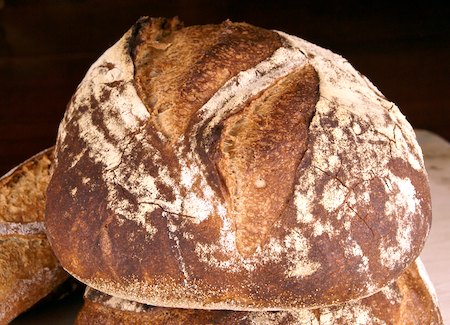
Call me shallow, but I do judge books by their covers, and breads by their crusts. For most of the hearth loaves I bake, I’m looking for a gorgeously brown, thin, crisp crust that “sings” when it comes out of the oven and shatters under the knife on the cutting board. I don’t always get it, but here are some things that help:

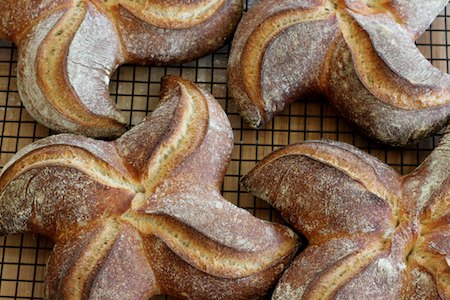
The three B’s (baguettes, batards, and boules) are classic, but maybe you want to mix up your loaf shapes now and then. Pinwheel loaves are an easy and fun change of pace. They are also good for people with fear of scoring, as no blade is required. They are not good for keeping birds away from your vegetable garden, however.
The loaves here are Norwich Sourdough, but you can use this technique with any medium-hydration dough. The shape is essentially two fendu loaves twisted in their centers and placed at right angles to each other.

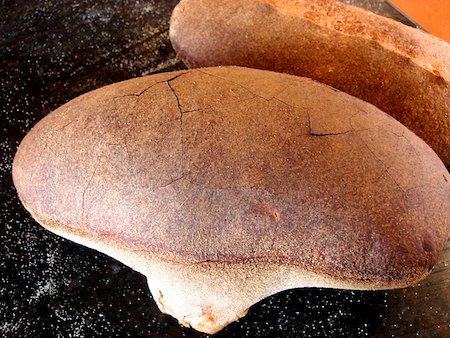
A blowout might be a good thing if you’re the birthday girl or the winning team, but when it comes to bread, usually not. In the scheme of things, a bread blowout may be a minor annoyance compared to, say, blowing out your front left tire on the freeway, but even so, I’d prefer not to have anything resembling the Goodyear Blimp on my dinner table.
My friend and baker extraordinaire Natashya (Living in the Kitchen With Puppies) asked me for help understanding why her loaves (of which the above is not one; I take full credit for that one) had exploded open like Aliens. I get asked this question fairly frequently, so here’s what I know (or I think I know) about it.
In general, a blowout happens when the crust sets before the inside has finished expanding. This can happen on the top, bottom, or side of the loaf. One or a combination of factors can be the culprit:
The San Francisco Baking Institute, from which I graduated earlier this year, has launched a series of baking videos as a companion to its comprehensive textbook, Advanced Bread and Pastry.

I can’t comment on the series in general as I haven’t seen it, and there is an annual access fee, but one of the free sample videos is on shaping a baguette. It’s worth a look. It explains the process in clear detail, but starts from the point where the dough (about 350 grams) has already been preshaped into a cylinder.