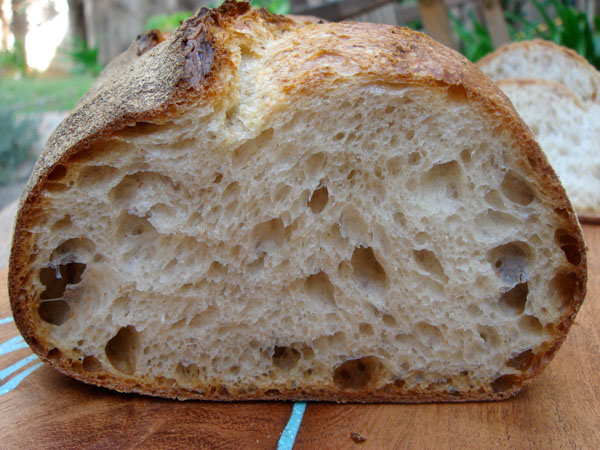
My New Favorite Sourdough
I love baking all kinds of bread, but a basic sourdough loaf is an essential staple at our house. Good with everything from blue cheese to blueberry jam, and quite possibly even better unadorned, we always feel something is missing if there isn’t a loaf resting on the cutting board, ready for a quick snack or a hearty sandwich.
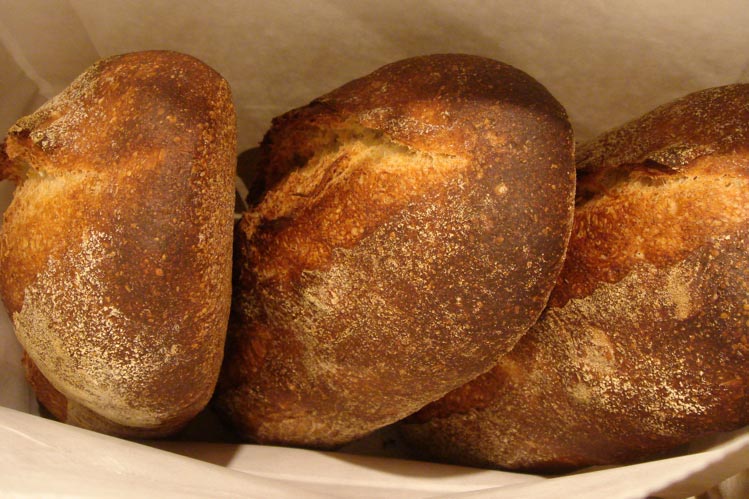
I first tried this recipe, adapted from the Vermont Sourdough in Jeffrey Hamelman’s Bread: A Baker’s Book of Techniques and Recipes, about a month ago. I loved it then, and have made it several more times since, to make sure the first time wasn’t just beginner’s luck. Nope; this one is a real winner. It’s a plain, honest, not-too-sour sourdough with a touch of pumpernickel for depth of flavor. With a thin, crisp crust and soft but substantial crumb, this is now my go-to bread for everyday good eating, anytime, with anything.
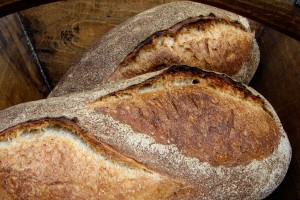
The original recipe calls for 125% hydration starter. I adjusted it to work with mine at 100%, and made a few other tweaks as well. I am calling it Norwich Sourdough, in honor of the home town of Hamelman’s King Arthur Flour bakery. And this charming Vermont town, as it happens, was my home, too, for five memorable years.
Norwich Sourdough
(adapted from Vermont Sourdough in Bread: A Baker’s Book of Techniques and Recipes by Jeffrey Hamelman)
Yield: 2 kg (four or five small, or two large, loaves)
Time:
- Mix/autolyse: 35 minutes
First fermentation: 2.5 hours
Divide, bench rest, and shape: 20 minutes
Proof: 2.5 hours (or 1.5 hours, then retard for 2 – 16 hours)
Bake: 35 minutes
Desired dough temperature: 76F
Ingredients:
- 900 g white flour (I used Heartland Mills unbleached malted all-purpose)
120 g whole rye flour (I used KAF pumpernickel)
600 g water at about 74F
360 g ripe 100% hydration sourdough starter
23 g salt
Method:
- In the bowl of a stand mixer, mix the flours, water, and starter on low speed until just combined, about one minute.
- Let the dough rest (autolyse) for 30 minutes.
- Add the salt and continue mixing on low or medium speed until the dough reaches a medium level of gluten development. This should only take about 3 or 4 minutes.
- Transfer the dough to an oiled container (preferably a low, wide one so the dough can be folded without removing it from the container).
- Ferment at room temperature (72F – 76F) for 2.5 hours, with folds at 50 and 100 minutes.
- Turn the dough out onto a lightly floured counter. Divide it into 400g – 500g pieces. I usually make four 400g loaves and refrigerate the rest to use for pizza dough later. Preshape the dough pieces into light balls.
- Sprinkle the balls lightly with flour, cover loosely with plastic, and let rest for 15 minutes.
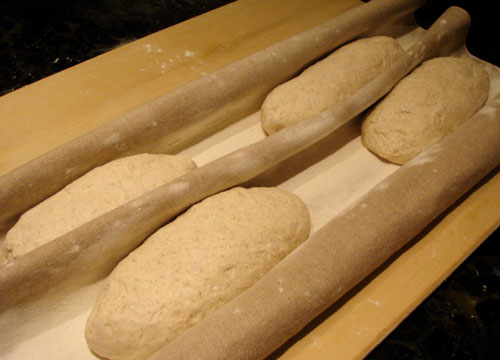
- Shape into batards and place seam-side-up in a floured couche or linen-lined bannetons.
- Slip the couche or bannetons into a large plastic bag or cover with plastic wrap and proof at room temperature for 2 – 2.5 hours. Alternatively, the loaves can be proofed for about 1.5 hours at room temperature, then refrigerated for 2 – 16 hours and baked directly out of the refrigerator; this will yield a tangier bread with a lovely, blistered crust.
- Meanwhile, preheat the oven, with baking stone, to 475F. You will also need steam during the initial phase of baking, so prepare for this now.
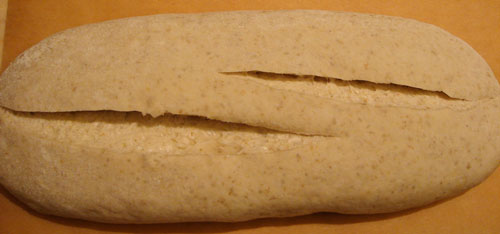
- Turn the proofed loaves onto a semolina-sprinkled peel or parchment. Slash each one with two overlapping cuts that are almost parallel to the long axis of the batard.
- Once the loaves are in the oven, turn the heat down to 450F. For 400g loaves, bake for 12 minutes with steam, and another 15 – 18 minutes without steam. I leave the oven door cracked open a bit for the last 5 minutes of this time. The crust should be a deep brown. Then turn off the oven and leave the loaves in for 5 minutes longer, with the door ajar, to help them dry. Larger loaves will need to be baked longer.
- Cool on a wire rack. Don’t cut until the loaves are completely cool, if you can manage it!


ejm July 10 2007 at 09:46 am 1
Oooh, that looks delicious!
Did you capture your own yeast for your sourdough starter?
-Elizabeth
Susan July 10 2007 at 02:56 pm 2
Thanks Elizabeth! Yes, I did raise my own starter for this. I’m going to be posting about that soon.
ejm July 11 2007 at 12:02 pm 3
I’m really looking forward to reading about your starter, Susan.
I’m on day 5 (again) of capturing my own yeast. I’m getting nervous that it’s not going to work but absolutely determined that it will….
-Elizabeth
Ann Timms August 10 2007 at 01:14 pm 4
Susan, I love this bread! I don’t have a mixer so did it by hand and as I said on TFL I made a real mess when I kneaded in kosher salt! Took some extra kneading and stretching but once I had fixed it the dough was a delight. I had also whined pitifully on TFL because I couldn’t get crisp crusts, but with these loaves the crust was crunchy - and I got EARS! Many thanks, Annie
bluezebra August 15 2007 at 01:37 pm 5
Hi Susan! I love your site and you already know I’m a big fan of your baking!!!
BZ
Susan August 16 2007 at 05:27 am 6
Elizabeth: you’ve gotten your starter off the ground by now. Looking forward to seeing more of your bread.
Annie: ears, crisp crust — all good. Keep baking!
BZ: thanks! You’re no baking slouch yourself.
Gena Lora October 19 2007 at 01:45 pm 7
I love this site. I made the melon pan, it was cool!
Is it possible to put the bakers percentages on the recipes? If not, I will still love the site.
Gena
Susan October 20 2007 at 07:24 am 8
Hi Gena Lora, I’m so happy you like my blog. The melon pan is fun, isn’t it?
It has been my plan to include baker’s percentages with the recipes; however, I thought it might be confusing to do that without providing an into to baker’s math for those who aren’t familiar with it, and I haven’t gotten that done yet. I’m working on it though; look for it soon!
L November 4 2007 at 12:59 am 9
made this for my co-op using SF bay area wild yeast starter — they loved it!
Daniel December 10 2007 at 05:23 pm 10
I made a few loaves of this great recipe! Let be say I had a breadulous experience. For the first time, I am so proud of my bread. With your help I have finally created something beautiful. I raised my own starter and here are the results:
http://picasaweb.google.com/daniel.divita/NorwichSourdough
Enjoy!
I can’t tell you enough, this blog is the best!!!!
Susan December 12 2007 at 08:34 am 11
L, I’m glad the bread turned out well. Lucky co-op!
Daniel, you have every reason to be proud, those loaves look fantastic. I’m so happy you let me know.
Daniel December 12 2007 at 12:27 pm 12
One question I have, is the dough supposed to be a bit sticky? The first time I made the dough it was really sticky so I added some more rye flour. It made it a bit more firm, but was still loose. Today, I made another batch and it came out just as sticky as the first. I added some more rye flour, but tried to keep it looser than my last batch. The first fermentation took off like wild fire. It will be interesting to see how these come out. Thanks again!
Susan December 14 2007 at 09:38 am 13
Daniel, “sticky” and “loose” are subjective but the dough is definitely on the somewhat sticky side immediately after mixing; it becomes less so as it ferments. If you would like your bread to have a more open crumb (interior), increase the water. For a less open crumb, decrease the water (and mix longer). I like to use water rather than flour to adjust the dough consistency so the ratio of flour to other ingredients is maintained.
Mike D December 22 2007 at 02:47 pm 14
This sounds absolutely delicious. It will accompany the coq au vin I make for my family on Christmas.
One question about the starter: does “ripe” mean at full rise in the daily cycle of the starter, or does it simply mean a starter that has matured and is capable of raising bread?
Susan December 22 2007 at 11:08 pm 15
Mike, this will go great with coq au vin. Sounds like a wonderful dinner. By “ripe” I do mean at full rise (i.e., several hours after feeding). Merry Christmas!
Lotte December 27 2007 at 09:13 am 16
Hi Susan,
Great blog you have! I already tried several of your recipes and they are all great.
Your sourdough bread and instructions to make a starter are great, it is the first time I managed to bake a good sourdough! I already made the bread succesfully several times. I baked it with steam and on a baking stone, and I tried baking it the KN method, and that worked great too.
One question though: your crumb seems very light and airy in the picture, mine is a tighter. Do you have an idea what might be the problem? I don’t use malted flour but bio all purpose flour, could that be it?
Thanks for your great website!
Lotte
Susan December 29 2007 at 08:22 am 17
Lotte, there are several things that go into achieving an open crumb. In general, the more water you use, the more open the crumb will be. The gluten needs to be developed sufficiently to support the large(r) air pockets, but if it’s developed too much the crumb will be very regular. Also, make sure you’re not overproofing the loaves or the crumb will be dense.
Lotte January 4 2008 at 02:02 am 18
Hi Susan, I tried using more water (50 grams) and kneading longer. Since I don’t have a stand mixer I use a handmixer and I think that calls for longer kneading also.
They turned out beautiful, with a nice open crumb!
Thanks for your tips and help.
Lotte
Mily January 5 2008 at 06:21 am 19
Hi Susan, I made this bread several times before followed the recipe posted on The Fresh Loaf. But this time I followed your recipe and baked the bread in the new set up oven similar to yours using lava rocks & hot water to create steam… It’s much improved as you can see the results here:
http://www.flickr.com/photos/sierravalleygirl/2168855820/in/set-72157600905528460/
It’s a not-so-bad crumb for hand-mixed dough –I was the mixer– ;o) and slashed with a utility blade, isn’t it?
However, the crust wasn’t as thick and as crackly as that of bread I baked in a closed-lid pot (in my pot baking days). I used about 2 x 3/4 cup of hot water in 2 times during the steaming phase. Could it be then the prolonged steaming phase the cause? Thanks.
Susan January 6 2008 at 08:14 am 20
Lotte, you’re welcome, I’m happy my suggestions were helpful.
Mily, great looking loaves, as all of your are! Steam is only helpful to a certain point, and if there is too much/too long it can compromise the crust. I use less than a cup of water, once only, and remove the steam pan after about 8-12 minutes. I think it depends partly on your oven, how good it is at keeping the moisture in, so experiment. I’ve found that keeping the loaves in the oven with the heat off and the door ajar for several minutes at the end of the bake, to drive off remaining moisture, is very helpful to producing a crisp crust.
Herb January 14 2008 at 11:42 am 21
I’ve been experimenting with sourdough for a almost a year and have had some success interspersed with some failures. Here is a link to some photo’s http://picasaweb.google.com/qiuruzheng
Yesterday I tried your technique of using a flower pot and unglazed tiles in a gas oven. It worked great, had wonderful blisters on the crust. I’ll do this again.
The main issue I’m struggling with now is getting the bread to taste sour. I use a starter I got from Sourdo
International (SF Starter) and it has plenty of rise and the container in the fridge makes lots of hooch so I assume there must be ample yeast and bacteria. For a Sunday bake I feed the starter Weds night and after a couple of hours on the counter put it back in the fridge. Friday morning mix a half cup starter, a cup of flour and half cup water and let proof for 12 hours at room temp (~66 F). Friday night punch down and repeat for 8 hours, Sat morning repeat for 4 hours in th eoven with light on (~ 80 F). Next, mix in 3 cups flour, cup water with salt dissolved. Let stand for half hour before knead. Then let rest for hour and begin stretch and fold for several hours. Into bannetons and retard in the fridge over night. Sunday morning take out of fridge at same time as pre-heat oven and then bake.
The bread has good crust and crumb, but not much in the way of sour. When I took the starter out before using the volume had increased and there were small foam bubbles on the top. So, I’m assuming the starter was good to go. With such long fermentation times I expect extra sour. The end result is faint sour.
Sorry for the long post, thanks in advance for any suggestions to increase sour.
Susan January 16 2008 at 01:03 pm 22
Herb, I’m having a little trouble following how you build up your starter, but in general sourness is favored by cooler temps and a stiffer starter. Your bread certainly looks great!
Herb January 17 2008 at 08:44 am 23
Here’s how I build up my starter: Feed the fridge jar a couple of days before using. Then take out 1/2 cup starter and mix with 1 cup flour and 1/2 cup water. Let ferment for 12 hours at ~66 F. Punch down and then mix with 1 cup flour and 1/2 cup water and let ferment for 8 hours at ~66 F. Punch down and mix in 1 cup flour and 1/2 cup water and ferment for 4 hours at ~80 F( would have tried 6 hours at 66 F but was running out of time). Then I mix in 3 cups flour and 1 cup water, salt and then autolyze, knead, proof and then retard.
I was thinking that the long cool ferments would enhance sour. I just shared these thoughts with Ed Wood who tells me that long cool ferments or proofs aid in yeast production and enhance rise at the expense of bacteria production while short warm 85-95 F ferments or proofs aids in bacteria production at the expense of yeast. So, this weekend I’ll try warmer and shorter proofs. I’ve also been using white flour exclusively and after experimenting with temps will try adding a bit of rye.
Susan January 20 2008 at 07:59 am 24
Herb, how interesting that Dr. Wood’s advice is exactly opposite of what I’ve been taught and experienced. I’ll be interested to hear whether your warm short proof gives you a less sour flavor.
Herb January 22 2008 at 08:23 am 25
Well, sorry to go on at such lengths with these posts. I can report that I did two experiments with proofing temps over the weekend. Both experiments produced the extra sour I was looking for.
With one I reactivated the starter at 80 F for 8 hours and then mixed up the dough, kneaded and proofed for 12 hours at 80 F. After 10 months of fooling around with sourdough I actually made
a bread which tasted sour. The only problem with this one was that I used too much water. The other experiment was with a three stage proof. I used 1/2 cup starter right from the fridge (a day after activation) added 1 cup flour and 1/2 cup water (85 F) and proofed at 85 F for 8 hours, punched down repeat two more times. Then mixed in 3 cups flour and 1 cup water, salt, autolyze, knead, rest, proof and bake. I usually use this 3 stage recipe with longer (12 hour) proofing at room temp (~66 F) and retard overnight before baking. The bread is almost sweet, no sour. Could only get to sour with the warmer proofs.
I’m puzzled with the results. I live near SF and would expect that historical use of sourdough was at similar temps as my room temp. I plan on more experimentation this coming weekend and will try to faithfully reproduce your recipe. Could you explain ‘ripe starter’? I’m guessing that it’s activated or recently fed.
Susan January 22 2008 at 09:54 pm 26
Herb, glad you found a way to get the sour you were looking for! By ripe I mean I’ve fed it several hours prior and it’s at its peak volume. See my post on how I maintain my starter for more info.
Caitlin April 14 2008 at 04:41 am 27
Hey Susan (just thought I’d respond on this rather than back on my blog) - when I finally decided that I’d try this recipe, I converted my starter to a 100% hydration. I’d been feeding it 1:1 by mass for a few days by the time I made the bread. Would that have given it enough time? The second loaf (that I refrigerated) didn’t flatten out as much. I wasn’t able to get a shiny crust though, even with steam and spraying it with water every minute for the first 10 minutes. Should I spray it some in the end as well?
Susan April 14 2008 at 05:33 am 28
Caitlin, yes, 1:1 feeds for a few days should get it very close to 100% hydration. Your crust looks good to me; it doesn’t have that chalky look you get with insufficient steam. However, I wouldn’t spray so often — you lose too much heat with all that opening of the oven door. I’m not a fan of spraying, I think there are better ways to steam. I explain what I do in my post about steam — steam at the beginning and don’t open the oven again for about 10 min. You definitely want DRY at the end for a crisp crust, so do not spray at the end.
Caitlin April 14 2008 at 10:18 am 29
Thanks! It’s reassuring that I had sufficient steam with that one. I think I just have to improve my steam technique a little, which might involve oven modification. Hopefully then I’ll get better oven spring and it will actually open up at the slashes.
Emilio May 15 2008 at 06:46 pm 30
hi Susan such a nice bread !!!
u wrote that u converted this bread from ha 150 % hydration sourdough to a 100 %
im wanting to do that with one of my recepies to..
thanks for reply !!