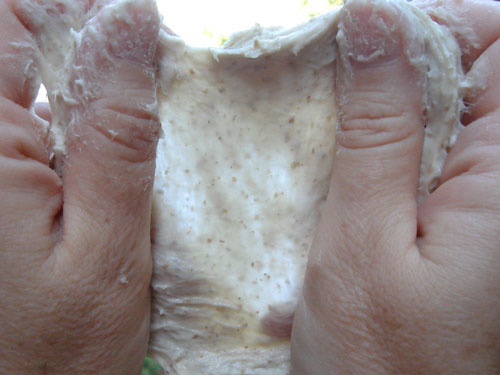
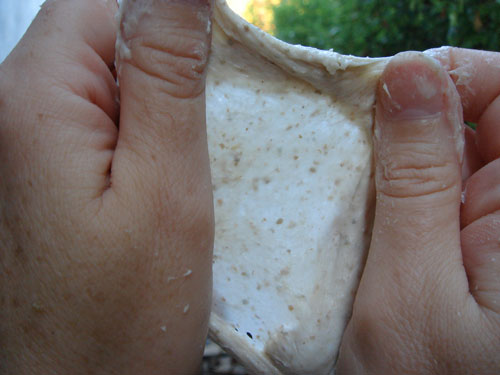
Gluten Development (with Windowpane Photos)

I took (actually, my husband T took, while I “windowpaned”) some photos of the stages of gluten development. I hope someone will find these useful. Most of the breads I make call for the gluten to be developed to a medium stage.

Gluten development is tested with the “windowpane test.” Pinch off about two tablespoons of dough and try to stretch it into a thin membrane (windowpane).

If you can do so without tearing, but the membrane is mostly opaque, you have barely developed gluten.

If you can stretch a paper-thin, very translucent windowpane, the gluten is fully developed.

A medium level is in between these two extremes: the windowpane is translucent with some opaque areas.

The progression from minimally to fully developed gluten:
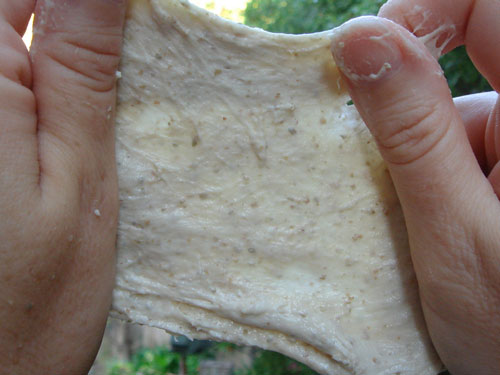
Low gluten development Medium gluten development High gluten development

Post a comment » 46 Comments

  1. [...] to a medium development although I’m really not sure. I learned this after seeing the pictures at Wild Yeast In the beginning my first windowpanes looked like the first picture, and how they more resemble [...]

  2. [...] Mix in medium speed about 10 minutes, until dough has reached a medium-high level of gluten development. The dough is soft and sticky. [...]

  3. [...] Reinhart warns that the dough may be too large for home mixers. Make sure that your dough passes the windowpane test after kneading. Prepare a lightly oiled [...]

  4. Hi,

    Thanks for the windowpane picks. Being new to baking wasn’t quite clear what I was shooting for – thanks again.

  5. Why medium stage instead of fully development stage?

  6. Macfield, full development generally gives a tight, even crumb (interior texture), which is desirable for some breads. For breads where you want a more open and irregular crumb, medium development is usually best.

  7. Are the pictures of the windowpains in reverse order? It seems that the one on the lift shows ligt and image behind it.
    The idea of showing the actual window pain results is a great idea.Thanks to Susan again.

  8. Herb, the photo on the left is the most opaque (i.e., the least developed gluten). There is a little translucency at the edges, so maybe you’re perceiving the edges of the opaque area as an image behind the dough. This is like a Rorschach test :)

  9. [...] und Salz hinzugefügt und etwa 7 min geknetet (mit der Küchenmaschine), bis der Teig den “Fenstertest“  [...]

  10. [...] bit. I then let it rest for 2-3 minutes and knead it for 10-15 minutes until the dough passes the window pane test. Lightly oil a bowl, put the dough inside turning to coat. Cover the bowl with plastic wrap and let [...]

  11. [...] l?tai maišome, kol viskas.. susimaišo (apie 5 minutes). toliau maišome, kol glitimas vidutiniškai susiformuoja. ?maišome likus? vanden?; minkome, kol tešla pasidaro vientisa (d?mesiaus – ji bus minkšta, [...]

  12. [...] wird, dann die Maschine höherstellen und weiter kneten, bis zu einer mittleren Glutenentwicklung (Fenstertest), etwa weitere 3 min. Nun wird der Zucker in kleinen Portionen (ca. 20g pro Portion) hinzugefügt [...]

  13. [...] point where it seemed tacky, but not sticky.  To check if the gluten had developed enough, I used the windowpane test (also called membrane test).  This is not an easy thing to photograph, so I was lucky to have my [...]

  14. Thank you so much for this demo. It has changed my sourdough making. I was never sure what I was doing and I just crossed my fingers. Now, I know what to look for.

  15. [...] into the greasy inner workings of the mixer. It was not pretty! Anyway, it will definetely pass the windowpane test. (Note: See a great picture tutorial on what it’s supposed to look like here.)3. Place into a [...]

  16. [...] into the greasy inner workings of the mixer. It was not pretty! Anyway, it will definetely pass the windowpane test. (Note: See a great picture tutorial on what it’s supposed to look like here.)3. Place into a [...]

  17. [...] I kneaded and kneaded and kneaded.  After ten minutes, I had managed to incorporate about half of the extra flour.  The dough was getting somewhere, but the gluten hadn’t developed enough to pass the windowpane test. [...]

  18. [...] kneading for 6 or 7 minutes in my stand mixer, I gave the dough the windowpane test.  Although it was hard to photograph, this was the best windowpane I’ve ever achieved!  [...]

  19. Thank you so much for this explanation! When I did my cinnamon rolls, I only had medium gluten development. Does this mean that I need to knead it longer in order to reach full development?

  20. [...] linki:- sk?adanie ciasta chlebowego w czasie ro?ni?cia- gluten- sk?adanie owalnych bochenków wg Tatter – metoda I i metoda [...]

  21. [...] forever, probably 2o or 25 minutes. When it’s done it’s supposed to be able to pass the window pane test. I don’t think I’ve ever gotten dough to that point, but after it rises for a few hours [...]

  22. [...] and I would be surprised if I kneaded for longer than 5 minutes let alone 10. I also skipped the windowpane test, which is the test to make sure the dough has been kneaded for long [...]

  23. [...] 2 until the gluten has developed. I usually check mine after 8 minutes of kneading. Here’s a link to help determine when the gluten has developed. If you’ll oil your hands before working with [...]

  24. [...] salt and knead for another 10 minutes, or until the dough is elastic and stretchy and can pass the windowpane test. I would post my own helpful picture here but this was a pretty messy dough and I didn’t want [...]

  25. [...] Windowpane test from Wild Yeast [...]

  26. [...] I also ended up kneading it longer than the book suggested in order for the dough to pass the windowpane test.  Because of the extra kneading, my dough temperature was higher than it should have been.  The [...]

  27. [...] together in a stand mixer; knead with a dough hook at medium low speed until the dough passes the windowpane test. Next, divide the dough into three balls, coat with olive oil, and rest at room temp for 15 [...]

  28. [...] will have been evenly distributed, and the dough will be evenly hydrated) and will pass the windowpane test. Kneading is actually a technique, so you should look up how to do it or have someone teach you. [...]

  29. [...] you just want to experience the pleasure of working with bread dough!). Knead until it passes the windowpane test, with a 5 minute rest halfway to allow the dough hydrate and the gluten to relax [...]

  30. [...] and didn’t reach the top, see? Or maybe it’s because the dough managed to pass the windowpane test this [...]

  31. [...] Pre-Kitchenaid, it used to take me 30+ minutes of hand-kneading to get the dough to pass the windowpane test, sadly raising actual concerns that my hands would fall off.  (I am the first to admit I have [...]

  32. [...] Pre-Kitchenaid, it used to take me 30+ minutes of hand-kneading to get the dough to pass the windowpane test, sadly raising actual concerns that my hands would fall off (in which case I really would need a [...]

  33. [...] Pre-Kitchenaid, it used to take me 30+ minutes of hand-kneading to get the dough to pass the windowpane test, sadly raising actual concerns that my hands would fall off (in which case I really would need a [...]

  34. [...] check if it had been kneaded enough, I used the windowpane test (which is rather hard to photograph alone, by the way).  It passed with flying colors, so it was [...]

  35. [...] check if it had been kneaded enough, I used the windowpane test (which is rather hard to photograph alone, by the way).  It passed with flying colors, so it was [...]

  36. [...] right – soft and supple, tacky but not sticky.  I checked the gluten development using the windowpane test, and it looked [...]

  37. [...] right – soft and supple, tacky but not sticky.  I checked the gluten development using the windowpane test, and it looked [...]

  38. [...] check if it had been kneaded enough, I used the windowpane test (which is rather hard to photograph alone, by the way).  It passed with flying colors, so it was [...]

  39. [...] Whisk the flours, salt, and yeast together in a large bowl, and mix in the butter until it’s pretty well incorporated into the flour. Slowly stir in the water until the dough begins to form a ball in the bottom of the bowl. Knead the dough in the bowl of a mixer for about 6 minutes, or by hand on a floured work surface for about 10. You want the dough to be smooth, and to achieve that all-important windowpane effect. [...]

  40. [...] Knead on medium-speed for 10 minutes or until dough is kneaded (must pass the window pane test). [...]

  41. [...] But baking has never been a subject I'm comfortable with. Give me a skillet, some pasta, and a well-stocked pantry and I can improvise countless meals. But if I'm supposed to bake something, I freeze. I immediately picture failure, a leaden cracker or a gummy mess. I hate the confusion of baking, the way it never quite turns out how it's supposed to in the recipe. I hate the way flour gets all over the place. And more than anything else, I hate the conflicting information, recipes never agreeing with each other, and how no matter how long I knead my bread I never get that damn "windowpane" effect that everyone talks about. [...]

  42. [...] mostly passed the windowpane test.  If you look closely you can see that it’s tearing in spots in the middle, but it was good [...]

  43. [...] 6 minutes or until the dough is soft and pliable, tacky but not sticky. The bread should pass the windowpane test and register 77° to 81°F. If the dough hasn’t fully developed, it can be kneaded more. It [...]

  44. [...] fine. Continue kneading the dough until you achieve good gluten structure and the dough passes the windowpane test. This took me about ten minutes by [...]

  45. [...] bit. I then let it rest for 2-3 minutes and knead it for 10-15 minutes until the dough passes the window pane test. Lightly oil a bowl, put the dough inside turning to coat. Cover the bowl with plastic wrap and let [...]

  46. [...] for about 10 minutes, or until the ingredients are evenly distributed. The dough should pass the windowpane test and register 77 to 81 degrees [...]

Post a comment