Archive for the 'tools' Category

Super Peel Giveaway

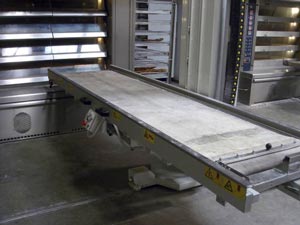
loaderThis is a loader.

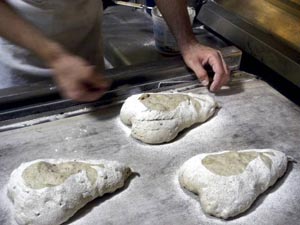
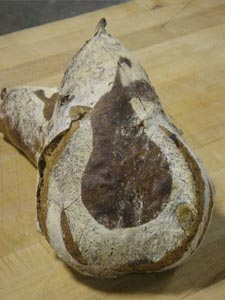
It’s what we use at SFBI to deliver about 20 loaves at a time into the deck oven without harming one strand of gluten on their pretty little heads. This canvas conveyor belt does a great job of ensuring, for example, that our lovely pear-shaped loaves don’t wind up becoming oranges or bananas on their way into the oven.

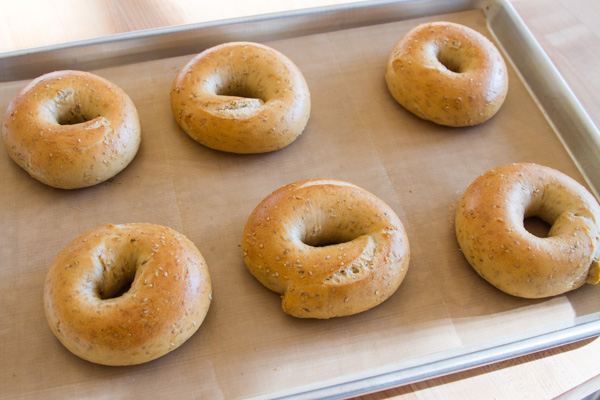
pear-loaves pear-loaf

Super Peel

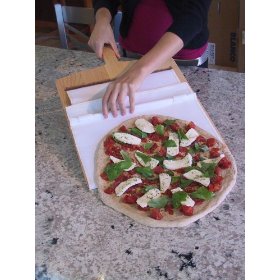
This is a Super Peel.

It’s what you can use at home to pick up your own pears, pizzas, or pains de campagne and deposit them onto your baking stone equally unscathed. And although it’s modeled after those big conveyor belts, it’s far more versatile. The SFBI loader can’t pick up a rolled-out pie crust from the counter and move it onto the pie dish, or transfer a freshly-ganached cake from wire rack to serving plate, but the Super Peel is great for these tricky jobs.

Check out videos of the Super Peel in action at the Super Peel website.

Thanks to Gary Casper, Super Peel’s inventor, you can have a chance to win a Super Peel (your choice of original maple or gorgeous new butternut) just by being a US resident and leaving a comment here by 11:59 PDT on Friday, October 23. Gary will even upgrade to a gift set — including a cloth storage bag and an extra cloth belt — if the comment I pick at random is super good (as judged by me).

Brotforms Winner

I apologize for not announcing the winner of the brotforms earlier. If you haven’t heard from me, you didn’t win, I’m sorry. The only person who has heard from me is Dave R from Boston, MA; congratulations, Dave!

As I said before, I highly recommend Brotform.com for your brotform needs. Good selection, good prices, fast shipping, nice people. So go order some.

Brotform.com Giveaway

Got brotforms?

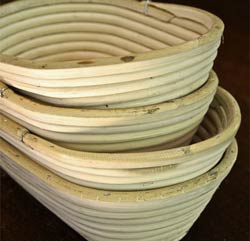
These coiled cane proofing baskets turn ordinary loaves into affairs of crusty gorgeousness. You can read more about their use and care here.

I’ve discovered that Brotform.com is a wonderful source for brotforms. Not only do their prices beat all others I’ve found by quite a bit, but my order arrived in record time and I did not feel gouged on the shipping charges. They offer a variety of sizes in round, oval, and oblong shapes.

All of this is, of course, meant to console and inform you in case you are not the lucky winner of the two brotforms — 9″ round and 8.5″ oval — that the very nice people at Brotform.com will send to a randomly-drawn commenter on this post, provided said commenter has a US shipping address.

So go on and comment it up before 11:59 PM PST on Thursday, July 9. Please make it interesting (but hey, no pressure!).

YeastSpotting 6.12.09

mosaic

See this week’s yeast spottings…

My Weigh Scales — Winners and Sources

I would like to wish happy weighing to Joey D of San Diego, winner of the My Weigh i5000 scale, and Nicole Dula of Dula Notes, winner of the KD-8000.

Next time I’m going to have to ask My Weigh for 247 scales, so everyone can win one. I’m not sure if they’ll go for this, though, so it might be a good idea to just get one. Here are a couple of online sources:

Amazon: i5000, KD-8000

Old Will Knott Scales: i5000, KD-8000

My Weigh Giveaweigh

I know I’ve said this before (and before and before and before), but I need to weigh in on this again:

If you’re not weighing your ingredients, you should be!

If you don’t know why, go scoot and read my small rant on weighing. (Summary: It’s accurate. It’s fast. It’s neat. Everyone who’s anyone is doing it.) Then come back, because I have something you might want.

For two years my trusty scale has been a My Weigh i5000. I love it because:

  • it is spot-on accurate
  • it can weigh in either grams (to 1-gram precision) or pounds and ounces (to 0.5-ounce precision)
  • it has a capacity of 5 kg
  • it is slim and lightweight and fits easily in a kitchen drawer (although I leave mine out because I use it daily)

I love my scale so much I thought I’d ask the people at My Weigh if they would give me one that I could give to one of you, and they were nice enough to say yes.

(Read more…)

Fibrament Stone Winner

It must be my old age catching up with me; I just realized I forgot to post the winner of the Fibrament Stone giveaway:

Congratulations to Lisa, whose new blog about handcrafted cards is worth checking out: dahlhouse designs.

Even if you do not have a new blog about handcrafted cards, you can still have a stone; order from Fibrament!

Everybody Must Get a Stone

(Public Service Announcement: Even if you know all about baking stones, you may find it worthwhile to read this post through to the end.)

You can spend a fortune on bread-baking tools and gadgets if you want to (and I admit I’ve done my part to stimulate that little piece of the economy). But when you get right down to it, the most glorious loaf can be produced using only a minimum of tools: your hands, a surface or container for mixing the dough, an oven of some kind, and something to hold the bread in the oven.

If you’re after crusty artisan (or artisanal, if you’re so inclined) hearth-style breads, that thing that holds your bread in the oven should be a baking stone.

When you put a loaf into any hot oven, the bread bakes by radiation (heat coming at the loaf directly from the element and oven walls) and by convection (hot air circulating in the oven chamber).

When you put a loaf onto a hot stone within a hot oven, the bread bakes by conduction as well; heat is transferred to the dough via direct contact with the hot stone. Conduction allows heat to be quickly and efficiently transferred through the entire mass of dough, which allows the interior to rise in the oven, and water to be evaporated away, before the outer crust has a chance to set and limit its expansion. The end result is that these loaves generally have greater “oven spring” and a crisper crust than pan-baked breads.

Another advantage of a stone is that it helps to maintain the oven at a constant temperature. The stone increases the thermal mass (heat-storing capacity) of the oven, so once the oven and stone are hot, the oven has to work less hard to stay hot, and the temperature recovers more quickly after opening the oven door than it does in a stoneless oven.

A baking stone can be as simple as unglazed terra cotta tiles available inexpensively from any building supply store, and of course there are several products specifically sold as baking stones.

For the past three years this Fibrament stone has been my stone of choice (you can tell because well-stained means well-used). It is thick and heavy, and while I can honestly say that other stones I’ve used have gotten the job done, there are a number of things that make the Fibrament my favorite:

(Read more…)

My (Non-)Bannetons

A while ago I wrote about brotforms, the German coiled cane proofing baskets that leave a spiral pattern on the crust of your loaf. What if you don’t have a brotform, or don’t want that spiral pattern? A banneton, French cousin to the brotform, is a woven wicker basket that usually has a linen fabric liner sewn into it.

A basket provides support for a proofing loaf; the linen liner reduces sticking and yields a smoother crust than an unlined basket. While I do proof most of my boules and batards in linen-lined baskets, they’re not official bannetons. Instead, I use loose pieces of natural unbleached linen that I lay inside of whatever basket or other vessel I want to use use for proofing. This works very well and has quite a few advantages over sewn-in liners:

It’s flexible. Any basket or bowl can be used; you don’t need special “proofing baskets.” I have been known to use decorative wicker or sisal baskets; the basket from my salad spinner; plastic chip baskets; and salad and mixing bowls made from wood, ceramic, plastic, or metal. Whatever size you need, you probably already have it around the house. Of course if you already have a brotform, you can lay a linen liner in that too, if you feel like it.

(Read more…)

Super Peel, Super Giveaway

Last week I mentioned the Super Peel in my Gift Ideas post, and I’d like to tell you a bit more about it, as it’s one of my favorite tools.

If you bake bread or pizza you know that a peel is used to transfer a loaf or pizza onto a hot baking stone. A traditional wood or metal peel must usually be quite heavily dusted with flour or cornmeal to allow the dough to slide off the peel and onto the stone without sticking — and sometimes it still sticks, especially if the dough is quite wet. Parchment paper can help, but it’s expensive, disposable, and burns at high oven temperatures.

The Super Peel is a clever answer to those problems. Modeled after the cloth conveyor belts that professional bakeries use to get loaves in and out of large deck ovens, the Super Peel has its own pastry-cloth belt that gently and efficiently picks up a pizza, loaf, or any other delicate or sticky item from a flat surface and deposits it, unscathed, anywhere you like.

Read more about the Super Peel and how you can win one…

Next »