Archive for the 'how to' Category

Let Us Now Praise Instant Yeast

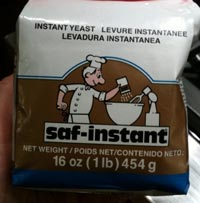
SAF Instant Yeast one pound packageIf you’ve made or read through any of my recipes, maybe you’ve noticed that when they call for commercial yeast, it’s the unfortunately-named “instant” kind. Unfortunately-named because doesn’t “instant,” when it comes to food, connote inferior and inauthentic? Can instant hot chocolate, instant onion soup, or instant rice ever measure up to the real stuff?

But instant yeast isn’t like that. It’s the very same organism, Saccharomyces cerevisiae, as fresh compressed (cake) and active dry, the other two forms of commercial yeast commonly available to home bakers. And plenty of professional artisan bakers use instant yeast too.

(Read more…)

How to Convert a Liquid Starter to a Stiff Starter

I normally maintain my sourdough starter at 100% hydration. That is, every feeding, and therefore the starter itself, consists of equal parts of flour and water, by weight. It has a batter-like consistency and is therefore a “liquid” starter.

But not every sourdough recipe calls for liquid starter; some call for a stiffer starter, often at 50% hydration (that is, the ratio of flour to water is 2:1). It’s easy to take a portion of liquid starter and convert it to a stiff one.

The easiest way to do this is to start with a small amount of liquid starter, say 10g, and feed it with 20 g of flour and 10 g of water. Then at every subsequent feeding, continue to feed with a flour:water ratio of 2:1.

The absolute amounts depend on feeding frequency, temperature, and individual starter characteristics. After a feeding, it should be able to at least double itself in several hours and hold there without collapsing until the next feeding. During cool winter months, I find feeding every 12 hours at a ratio of 1:2:1 (starter:flour:water by weight) works well. In the summer it might be, say, 1:3:1.5 or 1:4:2. But flour:water is always 2:1.

After a few feedings the new stiff starter is ready to go. Use it at its maximum volume, a few hours after it’s been fed.

How I Maintain My Sourdough Starter

Take good note of the title of this post: How I Maintain My Sourdough Starter. Yes, this really is all about me. If you talk to ten people you’ll likely get ten different but perfectly good variations on starter maintenance. This is simply an account of what I do.

Norwich Sourdough batards

The reason I do it is because it works for me. I won’t say I know nothing of the science behind it, nor that the science doesn’t interest me. But mostly I do what I do because it works and I get bread I like from it. If what works for you is to feed your starter pencil shavings and sing “Uncle John’s Band” before adding it to your dough, by all means keep doing that.

I keep one starter. It is a white starter at 100% hydration, meaning that I always feed it with equal parts of white flour and water, by weight. My current starter is one I started from scratch a few months ago.

(Read more…)

One Bread, Two Ways (98.4% Whole Grain Seeded Sourdough)

Better 98.4% Whole Grain Loaf

Did you look at the title of this post and think you were going to get something along the lines of one of those glossy magazine articles on how to live fashionably on a budget by taking a single outfit from the office to the evening with the simple addition of a few well-chosen accessories? (You know, the ones where you start with one ridiculously-priced suit, replace the businesslike button-down blouse with a silk décolleté cami, add the diamond necklace, Fendi bag, and Blahnik stiletto slides, and you’re good to go? Bargain city.)

Sorry to disappoint, but this isn’t exactly that. It is the decidedly less glamorous story of how I made two breads with EXACTLY the same ingredients (no baker’s diamonds here), the first only so-so and the next a bit better, by paying closer attention and changing just a couple of things in my method.

(Read more…)

Fendu, and a Bit About Spiking

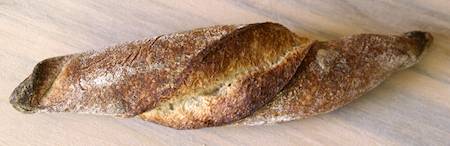
Fendu batards

This was going to be a post about one thing: shaping a fendu loaf. Then I ended up having to improvise a little with the dough formula, so it will be about that, too.

First, the fendu: I’ve been getting a little bored with basic batards lately, so I thought I’d do something just a bit different. A fendu (French for “split”) loaf is an easy variation that looks cool and offers a nice respite for those with scoring anxiety.

(Read more…)

Flour + Water = Starter

Ah, summer… corn on the cob, lazy reading in the hammock, and… sourdough starter, of course!

Mature sourdough starter

I’ve been taking advantage of this warm weather to try raising some starters from scratch. I had done it before in a week-long class (in fact, that’s the starter I’ve been using for months), but we were able to keep our cultures at a constant 80 degrees F, and we added extra malt to jump-start the process. I wanted to see how it worked with just flour and water, in the warm but fluctuating room temperatures of my non-air-conditioned house in these beautiful early summer weeks in northern California.

Success! Raising a starter seems to be something that is perceived as mysterious, complicated, or hard. But in my experience, it’s not; it just requires attention and patience.

(Read more…)

Folding the Dough: Video

Folding the dough (also called turning, stretch-and-fold, or punch-and-fold) during the first fermentation helps to develop the gluten and increase the strength of the dough. This means that the dough can be worked less during mixing; this is beneficial because excessive mixing can oxidize the dough, which detracts from flavor and crumb color.
(Read more…)

Gluten Development (with Windowpane Photos)

I took (actually, my husband T took, while I “windowpaned”) some photos of the stages of gluten development. I hope someone will find these useful. Most of the breads I make call for the gluten to be developed to a medium stage.

Gluten development is tested with the “windowpane test.” Pinch off about two tablespoons of dough and try to stretch it into a thin membrane (windowpane).

If you can do so without tearing, but the membrane is mostly opaque, you have barely developed gluten.

If you can stretch a paper-thin, very translucent windowpane, the gluten is fully developed.

A medium level is in between these two extremes: the windowpane is translucent with some opaque areas.

The progression from minimally to fully developed gluten:

Low gluten development Medium gluten development High gluten development

Why Worry About Water (Nifty Calculator Included)

water.jpgI know what you’re thinking: Can she really have written this much about water, the most boring of bread ingredients? This girl really needs to find something to do.

But wait: water’s function is much more interesting than simply that of the matchmaker that brings flour, yeast, and salt together. The quality of my bread really improved once I learned how to adjust the amount and temperature of the water to control some characteristics of the dough.
(Read more…)

Steam

No Steam vs. SteamSteam is important during the initial phase of baking most hearth breads. It facilitates oven-spring by preventing the crust from setting too rapidly, and enhances crust color. Breads baked without steam can taste fine, but the crust is likely to be a dull, pale grayish color rather than the rich brown most of us are after. Ready for a photo quiz? Hint: the top thing is not a peanut on steroids.

I have spent way more time than I should have scouring books and online articles and discussion groups looking for the perfect way to introduce steam to my baking loaves. I’ve spent hours and hours, and more than a little money, trying just about everything. But in the end, it’s come down to two methods that work for me.
(Read more…)

« Prev