Take good note of the title of this post: How I Maintain My Sourdough Starter. Yes, this really is all about me. If you talk to ten people you’ll likely get ten different but perfectly good variations on starter maintenance. This is simply an account of what I do.
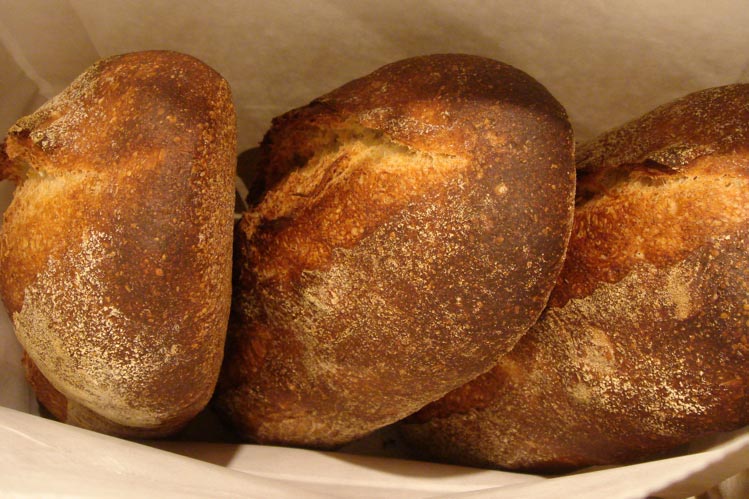
The reason I do it is because it works for me. I won’t say I know nothing of the science behind it, nor that the science doesn’t interest me. But mostly I do what I do because it works and I get bread I like from it. If what works for you is to feed your starter pencil shavings and sing “Uncle John’s Band” before adding it to your dough, by all means keep doing that.
I keep one starter. It is a white starter at 100% hydration, meaning that I always feed it with equal parts of white flour and water, by weight. My current starter is one I started from scratch a few months ago.
Unless I am going to be out of town or otherwise unable to feed it, I keep my starter on my kitchen counter and feed it twice a day (approximately every 12 hours). Because planning ahead is not my forte, and because refrigerated starter needs to be taken out and fed for two or three days before baking to restore it to maximum vigor, and because I often bake with my starter more than once a week anyway, I decided to just keep it ready to go at all times.
Normally I maintain about 100 grams of starter. I generally use a ratio of around 1:5:5 (starter:flour:water, by weight). So at each feeding, I remove all but around 10 grams of starter from the container and add approximately 50 grams of water and an equal weight of my usual bread flour.
I shake the starter and water together vigorously before adding the flour; the theory is that this will introduce oxygen, which promotes yeast reproduction, into the mixture. The truth is, I don’t know if that’s really happening. It does get the starter nicely dispersed, though. Then I stir in the flour with a spoon (yes, a metal one; it doesn’t hurt!).
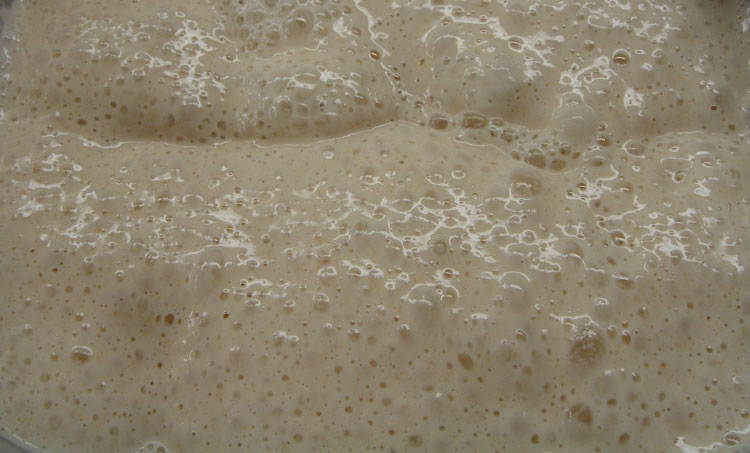
I arrived at the 1:5:5 ratio simply by observing how much flour my starter seems to be able to “eat” in 12 hours. I’m looking for it to at least double in volume in about 8 hours, with a surface that is well pebbled with bubbles (but not foamy), and a light, airy texture like the inside of a perfectly-toasted marshmallow. If it’s runny (like that marshmallow was really well-done), it’s overripe. And if it’s still thick and pasty, it has not peaked yet. Once it peaks, it stays pretty much there for a few hours.
The temperature in my kitchen varies with the weather (especially in summer, since we don’t have air conditioning) and yeast are “hungrier” when it’s warmer. Therefore, I feed the starter more in hot weather. There have been times this summer when I have fed at 1:6:6, just following my observations and intuition. On the other hand, this winter, when my kitchen will be much cooler, I may reduce it to 1:4:4, and even less for the nighttime feeding.
If the starter is acting a little sluggish, I substitute whole rye flour for about 5% of the white flour, for one feeding. Rye is great for really getting fermentation going.
When I want to use the starter, I need more of it. On the feeding before mixing the bread, I just increase the amounts of everything, keeping the same starter:flour:water ratio, so I wind up with the amount I need for the dough, plus a little extra, to keep the starter going. It will be ready to use in 8 – 12 hours. (Okay, so I guess I am capable of planning a little, but it’s only a few hours ahead, so it’s manageable.)
But what if I need a rye starter for a particular bread, or a stiff one? Some people maintain multiple starters, but that’s not going to happen for me; I know my limits. If I set my mind to being uncharacteristically organized, I’ll start a few days ahead of time to convert a portion of the white starter into the one I need. But sometimes I just pretend, for example, that my white starter is actually a rye one, feed it once with rye flour to build it to the amount the recipe needs, call it good and hope for the best. It either works fine or not, but what the heck. This is bread, not birth control.
 I am frugal by nature, and when I started this every-12-hour feeding business I admit I was bothered by the thought of throwing away all that excess starter. I decided my options were to A) find a different hobby, B) figure out something to do with the “waste,” or C) get over it. I settled on a combination of B and C. English muffins are a fine way to use a small amount of starter, as are sourdough pancakes (stay tuned). But I still I end up throwing a dime’s worth of flour and water in the compost now and then, and I’ve decided that’s not worth losing sleep over.
I maintain my sourdough and levain at 100 % hydration, but I feed only 1:3:3. I have only small amounts and I also hate waste. So I adapted all recipes to my way, like the hemp seed rye bread
I maintain my sourdough at 100% hydration every three days – I keep it in the fridge when I’m not using it. I probably bake sourdough about once a week and still haven’t decided if I prefer the relative ease of using commercial yeast or the need for planning ahead (eek!!! plan ahead??? Me????) to get the superior flavour and aroma that sourdough bread offers.
I too can’t stand waste but must confess that I have composted a fair amount, justifying it by knowing that the garden will benefit…
-Elizabeth
This is bread not birth control! Hoot! Fur sur!
And even not perfect bread is so much better than the store. Looking forward to the pancakes.
Susan love hearing how you do it. You are obviously so successful at it!! I wish I had the discipline to let Stinky hang out on the counter, but like a bad mom, I sometimes forget to feed him. *blush* So he is safer in the fridge.
I adore using the leftovers for English muffins, sourdough pancakes and pita bread. YUM!
P.S. Your breads look gorgeous as always girl! 😀
BZ
Ulrike, the hemp seed rye looks very interesting.
Elizabeth, I love sourdough but commercial-yeasted breads are also very good, especially using a preferment. I don’t think you will have an inferior product just because you use yeast.
Tanna, it’s good to keep a little perspective, right?
BZ, I don’t want to admit how many times I’ve forgotten to feed mine. It bounces back from my abuse pretty quickly. Pita – good idea! Can you point me to a recipe?
Pita Recipe: I like using Manuel’s rye sour (100% hydration) from Laurel’s Kitchen Bread book kept in the refrigerator.
Freshly mill: 325 gr whole wheat berries (red) ,
50 gr buckwheat (whole with hull for sprouting, or groats),
40 gr rye sour (100% hydration),
296 gr water,
0.5-1.5 tsp salt,
1/2 tsp SAF instant yeast (optional).
Hand mix into a shaggy mass. Mix in Kitchen Aid 4 min, low speed, with spiral dough hook. Refrigerate 8-24 hr. Take dough from refrig and de-chill for 1or 2 hr.
Form 55 gr dough balls. Roll out to 3/16 in thick round.
Heat a flat cast iron pan (medium heat) and dry fry until bubbles form (no oil needed); flip and cook 15 sec. Transfer to a just red hot electric coil to lightly brown each side. The pita puffs while on the first side. Experience will guide you on how high to set the burner. Watch carefully and do not let the pitas burn!!
These cooked pita freeze well. They will re-puff in the toaster oven and form a wonderful crisp on the outside and a feathery light interior. Great flavor too.
Overall hydration-80%.
You can also raise the hydration to 87% and skip the Kitchen Aid mixing. Then stretch and fold 4 times (30 min intervals) during the bulk fermentation after the dough de-chills after refrigeration. Measure out 55 gr dough balls, tighten up tension of the dough balls by scraping along an unfloured, dampened board with a large scraper. Dredge each dough ball in flour and gently roll into a thin round. Cook on the stove top.
It’s not that I think the bread made with commercial yeast is inferior to the wild yeast bread (I usually do use a preferment – except for pizza, foccaccia, naan and our sandwich bread). It’s just that as they come out of the oven, the smell of the wild yeast bread is so amazingly good in comparison to the smell of the bread made with commercial yeast. It’s as if there is something missing from the commercial yeast bread (and I guess, in fact, there IS something missing – I’m guessing the lactobacilli??)
However, the jury is still out on whether wild yeast bread tastes better than commercial yeast bread….
-Elizabeth
Thanks. I abuse my starter quite often.
Will try your english muffin when I refresh my starter next time.
I’ve killed my wild starter a few times by neglecting it on the counter, but after devouring “Local Breads” recently I was inspired to keep some going with more regularity. It’s worth it, and as he points out, you can easily change it over to a different kind with a little planning!
Elizabeth, I like the taste of both. Depends on what I’m in the mood for.
Kim, I hope you like the muffins!
Rose, Local Breads is a great book, isn’t it? I’ll look forward to seeing some of those breads on your blog.
I, too, feel bad sometimes when I toss out starter, but if you have a septic system, it can really benefit from all that yeast!
As for pita bread, a couple of years ago I embarked on The Pita Project, in search of the perfect recipe. I’m certainly no pita puffing expert, but I quickly became addicted to pita pizzas made with the unpuffed ones. 😉
Farmgirl Susan, I sometimes bake and tend my starter in a house with a septic system. I never though about the starter being good for it, so thanks for that! Your pita pizzas look amazing.
I’d like to know what you do to your starter if you have to be out-of-town for about 2 weeks? I keep mine in the fridge and feed it once weekly.
Fantastic Blog, thank you for such clear, concise directions, and explanation of the “why” as well. Beautiful breads,too. The Norwich Sourdough will be my first attempt at one of yours tomorrow…I hope. I’m trying to convert from Peter Reinharts feeding schedule in BBA to something similar to yours and my starter seems a bit slower than usual so far. Thanks again & looking forward to the Norwich Sourdough.
Lonely Kitchen, I refrigerate my starter when I’m out of town, then revive it with about three days of feedings before using it again.
Dan, thanks! Good luck with the Norwich SD, let me know how it turns out.
I think there’s something in the whole shaking of the starter and water to incorporate oxygen. I’ve been doing it that way this week, and I’ve had to keep the plastic container slightly open, because otherwise the top blows off, and that’s never happened before.
Also, it cleans off the sides, so you have more control over how much starter you have in the container (less clinging to the sides over time, which could make a fair difference when trying to get only 10 g of starter).
I prefer to think of dumping the starter as “setting it free.”
Hello Susan,
I have been baking bread for several years with commercial yeast using preferments, with pretty good success by now. But I just made my first wild yeast starter and was hungrily looking for information about starters, and Googled ‘Wild Yeast’ and there you were!
Thanks for this great, helpful blog (I almost typed glob). BTW I made my starter from scratch, using KA organic whole wheat flour and pineapple juice. I was surprised to see a few bubbles by the end of the first day. By day four I had an amazingly bubbly starter, so now I’m ready to take the plunge and bake. Your blog, successes and fail… partial successes alike, is very encouraging. I see now that the amount of starter one actually uses is relatively quite small and am rethinking my refreshments.
Again, thanks for setting a great example and helping teach the world about wild yeast!
I’m a bit paranoid, as I am on day 3 of getting my starter going (it’s been good so far), but I’ll be on holiday for 16 days in a few weeks… can I leave it in the fridge for that long, or should I attempt to have my cat-checker feed it at some midway point?
Thanks for the inspiration, btw. ^_^
devlyn, if it were me I’d just leave it in the fridge and revive it when I returned. Your mileage may vary. Good luck!
I have been reading everything I can about taming the wild yeast…I am a devotee of Straight Dough for my sandwich breads, but I love crusty, flavorful loaves just as much. I think I am ready to embark on a new “pet” project, and your blog has really encouraged me. You make it very accessible. Thank you for that. Quick question–have you ever had a starter go bad on you? How did you know?
Anna, I’ve always (knock on wood) had very good luck with starters. However, if I had one with colorful things growing in it, I’d chuck it.
Thanks – great blog – so many recipes and idea out there, it’s hard for the beginner! I gave birth to my first starter 5 days ago, bio yoghurt, organic apple juice and a few grapes (i know, I know LOL). Anyway, after 2 days WOW, amazing smell, fermentionville, and I was beating but not feeding (my recipe didn’t mention this). Now he seems dead, still smells good, but dormant at best. I’ve followed your advice and tried dumping 90% of it, and went with 10g starter and 50g water and 50g plain flour.. fingers crossed for the resurrection!
Just as an update, I took my starter out of the fridge on Monday after being gone for so long (I’ll be baking up a storm this weekend), and it’s already doubling after a few hours without any issues. I’m amazed! Ciabatta, here I come!
Ok-I am having a ton of fun trying to get the hang of my sourdough! Seems like each step gets me a little closer. I figured out I was starving my sourdough (I was just feeding 4 oz flour, 4 oz water, ever 12 hours regardless of starter size). So I’ve moved over to your suggestion of 1 part starter, 5 parts water, 5 parts flour- and WOW what a difference! Now it pops right up and doubles (even had a few spill over situations cause I just didn’t think it would rise that much). Anyways- it’s now doubling in about 4 -6 hours……is that ok- or does that mean I’m feeding it to much for my little yeasties? Also- I want to use it in batter when it has reached it’s full rise- but before deflation- right???
Thanks SOOO much for your blog! I’ve been loving and devouring every post!!!
Now what would you do for a 125% hydrated levain like Hamelmans, it’s 222% Levain,125% water, 100% flour, how would you maintain that?
Hello Susan,
I’m am trying to ofind an explanation for the throwing out of part of the starter before feeding… what is the idea there?
Pietro
Pietro, each time the starter is fed, it increases (by weight) approximately tenfold. If you didn’t remove some of it each time (either discard or use in bread or something else), you would quickly need a swimming pool to hold it all 🙂
I am having trouble with my start and wonder if you have a comment…the hooch has turned blackish…again. Is this because I occasionally use whole wheat flour when feeding it? It happened once before and i tossed it but felt terrible because it smelled great…I have trouble believing that is color is ok.
Susan – thanks so much for these instructions and recipes and for your great patience! You are a born teacher.
I’ve now baked a couple batches of bread with my new starter – one with the Norwich bread (a great recipe – I love what the bit of rye flour does) and one that ended up being about 50% white flour and 25% each whole wheat and rye, because I had forgotten to buy more flour. That was delicious too.
The mistake I made was doing a full recipe of the Norwich recipe, but I divided up the dough into four portions and stored three of them in the fridge and baked them one at a time over the next few days, and this actually worked quite well.
I am happier making smaller batches of bread, partly because I live alone, and partly because I don’t have a mixer. So that is what I am working on – an approach/recipe/method that lets me bake small, frequent batches of sourdough bread – but at the same time letting me sort of control the degree of sourness.
This is such fun!
It is really amazing the variation that can be created with such simple ingredients by making subtle changes in technique and fermentation times.
Thanks again.
Kris — to avoid hooch, feed your starter more, or more often. And while whole wheat flour per se does not produce black hooch, if yours is a white flour starter I would recommend feeding it consistently with white flour, although 5-10% whole wheat or rye flour, if the starter is acting sluggish, can jump-start fermentation.
Fern — thank you, and glad you’re having such success and fun!
If I have a recipe that calls for, let’s say 1 packet of dry yeast, can I use wild yeast starter instead? And how much starter if one packet is 2.5 teaspoons or .25 ounces?
I’m working with a Herman starter for the first time, its a little different than what you’re talking about for the fact that it eats mashed potato flakes, sugar and water for dinner, but otherwise works similarly. I’m concerned that my house is too cold to get Herman bubbling like he should after being fed. My house is probably 65 degrees f. during the day and maybe 62 during the night. Is there a “safe” way of warming it without overdoing it? Please help me save my starter!
Amy, during the winter my house is below 60 at night too, and not much warmer than 65 during the day. I feed mine less at each feeding during the winter months, because the yeast work more slowly in cooler temperatures. I’m not sure about the starter you describe, as I’ve never worked with that type of starter, but for my starter the cooler temperatures do not pos a big problem, once the starter is well-established.
I keep starter in the refrigerator and some on the counter also. For the last couple of weeks my starter has a crust on top of it (both in the fridge and on the counter) after a couple of days. I keep it at a pancake batter consistency. I do not feed every day and I don’t throw any out. I never increase the water and flour amount, no matter how much starter I put it into. Can you help me out?
Karen
Karen, I think I would start by being more consistent in how you feed the starter. Starters appreciate being fed on a regular schedule (at least once a day), especially if they are not in cold storage, and a consistent amount of flour and water per unit of starter (may vary some with temperature). A crust indicates to me that the starter may be drying out from not being fed enough.
Thank you so much for the advice. I’ll read your site more thoroughly and I’m sure I’ll get better at this. Much appreciated.
Sincerely,
Karen
Susan, I must grin when I read “This is bread, not birth control”. How true! I very often pretended my rye starter is actually a white one when I need some white levain to bake some bread.
I like to follow my instinct too. Well, not all the time works out fine though….
I sometimes use the discarded starter to make the pizza dough, or sometimes just adding them to the commercial yeasted bread dough for the sake of getting more flavour and aroma.
Sorry for being so blahblahblah….
Angie
Pls. entertain this anal-retentive question: is it possible to stir a starter too much? I feed my starter 2 times a day – is it possible to affect bread results by overmixing? Okay, so I am in love and totally fascinated with my beasties… what are your thoughts?
Susan, great blog. I’m going to try your feeding proportions, but I’m wondering if your starter produces a tart flavored bread.
My starter produces a wonderful, soft, moist crumb but almost no sour kick, despite refrigerator retardation on the first or second rise. I’m really trying for more sourness. Would appreciate any comments.
Gabrielle, you only need to stir the starter enough so that the flour and water are thoroughly incorporated, but I don’t think that if you mix a little beyond that you are in too much danger.
Robert, for a more sour bread, try using a stiffer starter (lower hydration) and/or feeding less often (but you will need to feed it larger meals in this case) and/or using a greater proportion of starter in the dough.
I’ve had my starter going for about a week and half now. It has a pleasantly sour odor and the roasted marshmallow texture, and it doubles in twelve hours, but it also has a ton of foamy bubbles on top at the end of that time. Is that a problem that needs to be corrected? I’ve only baked once with it, before it was ready. Thanks, you have a wonderful site!
Ang, it sounds as if you might need to feed your starter a bit more at each feeding. If you’re currently feeding, say, 1:3:3, try 1:4:4.
I bake intermittently, I’ll bake on weekends for months straight, then nothing for 3 months. When I’m baking on weekends I put my starter in the fridge on Friday immediately after feeding it. Feed it once on Monday. Then take it out Wednesday evening or Thursday morning doing the 12 hour feedings until Friday or Saturday evening when I mix and retard overnight for baking the next morning.
When I don’t bake I leave the starter in the fridge and don’t do anything to it. I’ve left it there for as long a six months.
When I start up again I dump off all the alcohol that is sitting on top, I keep about 100 grams of the remaining starter and mix it with the water. Then start the 24 hour starter cycle, If I start on Monday I can usually bake by Friday (starter fully developed in 8 hours or so).
Thank you Susan for such an informative site. I have become quite obsessed with my months-old starter and I wanted to weigh in on the subject of hydration and the correct amount to feed one’s starter for general purposes. I have been feeding my starter once a day by using what I thought to be 1:1:1 by weight: 1 Tb starter, 3 Tb water and 1/4 cup flour or 2 Tb starter, 1/3 cup water and 1/2 cup flour (I originally weighed everything and switched to American weights and measures). I thought this was what was meant by 100% hydration – adding equal parts flour and water to the weight of the starter. Hmm, now I’m confused. I haven’t had any trouble with my starter and the dough rises nice and slow and have had excellent results making several batches of pain au levain a week, bagels and English muffins.
marshmallows with cheese is the stuff that i always munch-:.
hello im new here and i’ve been reading all the posts on starters and maintaining starters …so im left wondering is the starter just for sourdougn bread?? im not a big fan of sourdough is there any other starters ??? i would really like to try the ciabatta buns r they sour??
i love to toast marshmallows in the fire, they taste twice as better when they are burnt ,;:
Hello everyone! I am brand new here and I need help! I have a sourdough starter, I started a few years ago and it is still alive! It’s sort of like family now, what with feeding it twice a day and hanging out in the kitchen with me. But anyway, I have used it many times in a recipe for bread but the bread never comes out very sourdough like. Maybe a hint of sour, but nothing like what I intended. I have tried adding rye flour, I have even added vinegar to the recipe with the starter, but I never get a real sourdough. What am I doing wrong? Please help. Thanks, Diane
Anda telah menyelesaikan beberapa poin yang baik di sana. Saya melakukan pencarian pada tema dan menemukan mayoritas orang akan memiliki pendapat yang sama dengan blog Anda.
Susan, your post is like balm on my wounded morale. Loved every bit of rebellion in here, as I am really doing rock bottom with my feelings. So I sat and read your page top to bottom and felt myself healing, seriously!
Your 3 options for excess starters are easily going to be applied by me to just about everything else that is being a pain in my life, right now!
Thanks so much 🙂
meera
Thanks to you and this post, I made my first truly successful loaf of sourdough bread last night. This was after several disappointing and novice attempts in previous weeks with my new starter. Gorgeous crust (ears!) and crumb. I literally danced a jig of joy when it came out of the oven. I found you through thefreshloaf.com.
Hi Susan! I have a purdy healthy ‘sourdough’ starter – a typical 100% hydration type I believe? Well, I did the 1:1 flour/water blend…I know I could have used flour/oj or flour/pineapple juice n the 1:1 ratio also..anyhow, mine’s basically 1:1 water/flour and a wee bit of organic grapes I used to get my yeasties going…
Well, it’s going!
Now I need to learn how to bake a decent piece of bread!!!!? Help!!! Lol
How do I NOT make a rock hard loaf?!?! Frusterated and need a recipe and or tips on how to make a soft usee/eater friendly loaf:/? Frusterated-but gettin there.
Hi, what a great site. Thank you for your time and effort in putting it together and maintaining it. Question, if I were to prepare a batch of starter to use in a recipe and then 8 hours later put it ins fridge to be used 1 or 2 days later, would that be ok? Or will refrigerating mess it up? Have you or anyone you know tried this? Thanks.
Hi Susan,
Only found your website today, I started my white starter 5 days ago using unbleached flour, starting ingredients 500g of warm water and 500g of bread flour, after 48 hours it was bubbling but I thought if I left it another 24 hours it would be more active but it wasn’t, I started to feed it , so I took out 500g of the starter and added back 250g water and 250g flour, I have continued to do this process of removing 500g of starter and adding 259g water and 250g flour every 24 hours, but I don’t think it’s active enough to bake bread, it will bubble up a few hours after I feed it , but not enough to bake with as I tried the float test. What I’m wondering is firstly do I need to feed every 12 hours and not every 24 hours? And with my starter recipe been quite big can I reduce the quantity that I feed it by reducing 250g each to maybe half that, I’ve used a full bag of expensive flour and no real success yet? Upside is that it’s smells nice and sour!
Thank you
Amanda
i have a question about my starter. i started my starter about 4 weeks ago .i thought i finally got my starter going because it would rise more than double in 4 hrs but never made bread with it just always used the discarded starter to make pizza dough,pretzels,english muffins and pancakes. anyways i wanted to take a break and i put it in the fridge after feeding it and let it let for a couple hrs. then i just took it out 5 days later to feed it but i didnt feed it soon as i took it out .i waited a couple hrs and i noticed it was extremely bubbley on top.. and normally i will only see bubbles on the sides of the mason jar and a couple on top when i stored it on the counter. but this was like if you blew air threw a straw into a glass of milk you get a cluster of high bubbles. does this mean my starter is really active and i should use that to make bread?? whats going on with my starter? thank you!
Once your line is as close together as they can get,
they now need to move together as one. You’ll find that contract renewals for your existing
players are also handled by agents now. It is undeniable that sportswear plays an important role in an athlete.
87c9c6c6ff5c99319e2ea0711c388d14