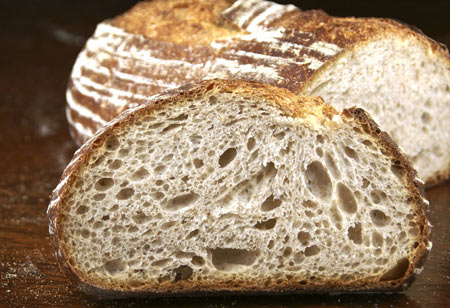
Norwich Sourdough, which was My New Favorite Sourdough when I wrote about it last year, is still my number-one no-fail go-to bread. (In fact, I was thinking of renaming it Three-Compound-Adjective Sourdough.) It’s mildly sour and goes with just about everything.
For those times when a more assertive tang is the order of the day, this variation serves nicely. It’s essentially the Norwich sourdough formula but with 50% more rye flour and 33% more levain. Just as Norwich Sourdough is based on Jeffrey Hamelman’s Vermont Sourdough, this is adapted from Vermont Sourdough With Increased Whole Grain, both from the essential Bread: A Baker’s Book of Techniques and Recipes.
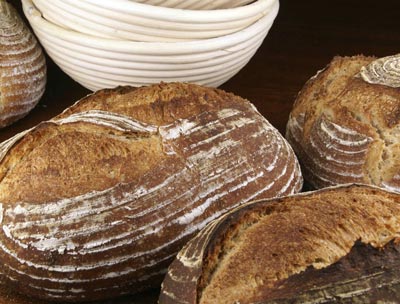
Norwich More-Sourdough
Yield: 2 kg (4 loaves)
Time:
- Elaborate sourdough starter: however long yours takes
- Mix/autolyse: 35 minutes
- First fermentation: 2.5 hours, with a fold at 1.25 hours
- Divide, bench rest, and shape: 25 minutes
- Proof: 2.5 hours (or 1.75 hours, then retard for 2 – 16 hours)
- Bake: 40 minutes
Desired dough temperature: 76F
Ingredients:
- 775 g flour
- 180 g coarsely-ground whole rye flour (such as King Arthur Flour pumpernickel)
- 560 g water
- 480 g mature 100%-hydration sourdough starter
- 23 (3.75 t.) g salt
Method:
- In the bowl of a stand mixer, mix the flours, water, and starter on low speed until just combined, about one minute.
- Let the dough rest (autolyse) for 30 minutes.
- Add the salt and continue mixing on low or medium speed until the dough reaches a medium level of gluten development. This should only take about 3 or 4 minutes.
- Transfer the dough to an oiled container (preferably a low, wide one so the dough can be folded without removing it from the container). Ferment at room temperature (72F – 76F) for 2.5 hours, with a fold at an hour and 15 minutes.
- Turn the dough out onto a lightly floured counter. Divide it into 400g – 500g pieces and preshape them into light balls. Cover loosely and let them rest for 20 minutes.
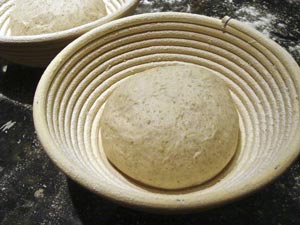
- Shape into boules or batards and place seam-side-up in a floured couche or proofing baskets.
- Proof, covered, at room temperature for 2.5 hours. Alternatively, the loaves can be proofed for about an hour and 45 minutes at room temperature, then refrigerated for 2 – 16 hours and baked directly out of the refrigerator; this will yield an even tangier bread.
- Meanwhile, preheat the oven, with baking stone, to 475F. You will also need steam during the initial phase of baking, so prepare for this now.
- Before baking, slash the loaves as you like.
- Once the loaves are in the oven, turn the heat down to 450F. For 450g loaves, bake for 8 minutes with steam, and another 22 minutes without steam. The crust should be a deep brown. Then turn off the oven and leave the loaves in for 10 minutes longer, with the door ajar, to help them dry. Larger loaves will need to be baked longer.
- Cool on a wire rack.
Hey you read my mind, I am making the old sourdough levain from the Coupe de monde 1994! Always two steps ahead, go Obama!
Beautiful bread!
Gorgeous Susan,
I was just reading your blog from start to finish, and decided want to try to make the starter using your recipe, then make the “Norwich Sourdough”. I am so excited, I will go to “WholeFoods” to buy the Rye flour. Wish me luck with the starter!
Cheers,
elra
well, I guess that does it for this weekend’s bread!
although I have to say your “couronne Bourdelaise” from the archives is tempting me – I think I need a little more practice before attempting that beauty, though. A real masterpiece of a bread that is!
Susan, I have a quick question for you – browsing through one of the books I bought per your recommendation, I noticed that one of the changes you sometimes make is using 100% hydration in place of a “harder” starter. Of course, I understand it’s always possible to do that adjusting the amount of water in the total recipe
I am just wondering – personally, do you find it better to use a higher hydration starter? Does that make a noticeable difference in the final product? Or is it a matter of convenience, maybe because you keep a 100% starter going at all times?
thanks!
Gosh I’m really loving that crust . . . well really each one of those crusts! Beautiful Susan. Great crumb too. But then it’s baked by Susan!!
I can’t wait to try this!
Wow, Susan! I love more sour dough. Awesome post. I made my first artisan loaf today.
Thanks for your comments, all.
Sally, I usually use a liquid starter because I find it’s just more convenient to maintain than a firm one (others will disagree). A firmer starter does give the bread more acidity, all other things being equal — at least that’s the theory. When I substitute liquid starter for firm in a formula, I increase the amount of starter so that the amount of prefermented flour (four contributed by starter) remains the same, and adjust the water downward. Converting my liquid starter to a firm one wouldn’t take any longer than making those calculations, so it’s not entirely rational. Go figure 🙂
I would have expected a darker crumb with that pumpernickel in it. Nicely done!
So this brings up a question. Generally speaking, how much dough do you use for what size banneton? I have three different sizes (2 are brotforms) and only one size batard shaped.
I have my own idea about this, but I’d like to compare.
Dolf, my scant 7.5-inch round brotform (interior diameter, measured at the rim) is good for up to 700 g or so. The 8.25-inch round is good for about 1 kg. My oval 7.5 x 5.5 works for up to around 500 g, and the oval 9.5 x 5.5 for about 700 g. All approximate, of course.
Thanks, Susan
I’ve been playing with the starter, sometimes liquid, sometimes firm. So far I cannot decide which one I am more comfortable with – at some point I want to bake the exact same loaf with two different starters, and compare – but right now I am just happily going from one recipe to another that winks at me 🙂
Your blog is certainly keeping me busy….
Dunno Susan,
Even after the class with Jeffrey Hamelman, I still can’t my loaf out of the fridge and into a hot oven without the occasional blowouts! ??? What is it the cold weather or should just let the dough sit out longer as I usually do???
Guru, help me!
I like how the holes seem like they’re trying to escape to the slash opening.
Susan, I made a loaf of this bread today; it was wonderful!!!! I scaled the recipe back by half with great success. We had our bread with a nice cabbage and ham soup. I’m going off to bed now so that I can wake early for toast with apricot preserves. 😉
Thanks so much. This truly is a delicious, moist bread with a beautiful, cruncy crust.
Jeremy – hmm, blowouts to me say underproofing, or overcrowding in the oven. Proofing longer before retarding would be the first thing I’d try.
Marie, that’s great!
Susan, beautiful loaves, as usual. The Norwich Sourdough is an old standby for me now.
A question for you (to add to the many above…): how much does the sourness of the dough depend on the local microflora. I’ve heard the San Francisco yeast/bacteria are able to thrive in acidic environments and that’s why the bread from there is so distinctively sour. Any insights into this…? Can I just blame my local yeast for my non-sour sourdoughs? 🙂
Claire, here’s an interesting read on the subject:
http://discovermagazine.com/2003/sep/featscienceof
That is the MOST PERFECT crumb – the gas bubbles streaming towards the slash!
Your site is the first one in my bread bookmarks but I doubt I shall ever equal your beautiful loaves.
Susan, I’ve been making the Norwich sourdough for months now, and only just recently, the crumb has been horrible. Really tight, with a few huge holes. Any ideas where to start trying to fix it? Is it my starter? Too much kneading? Too little kneading? The cold weather? Any advice is appreciated! I’m getting frustrated…
Thanks Susan
how can I make 480g Norwich Sourgough starter ,by weight?
can you name some good books about Bread?
Sarah, I emailed you.
Vahedi here are some posts on starting and maintaining a sourdough starter:
http://www.wildyeastblog.com/2007/07/13/raising-a-starter/
http://www.wildyeastblog.com/2007/09/29/maintain-starter/
Check out my store for a list of books I use and recommend:
http://www.wildyeastblog.com/astore/
This is my new favorite bread. OMG, so good!
the flavor was just that tangy sour that I have been looking for with a wonderful shattery crisp crust. we already ate the weekend batch, so will make a new batch tonight for baking tomorrow.
I’ve truly enjoyed this recipe over the last month – so much so that I decided to do a little modification of it yesterday! I substituted 10g vital wheat gluten and 275g whole wheat flour for the same weight of flour from the recipe. Baked off tow loaves directly (pictured at link below) and retarded two – they are in the oven now!! Great results still, but with a slightly denser crust (possible result of wheat, possible result of direct bake?) but great none the less. Thanks so much for sharing this site with all of us!
Greg
http://picasaweb.google.com/subdriver96/FoodPics?feat=directlink
Hi Susan – I’ve been following your site since I started trying to improve my breadmaking skills this summer. Thanks so much for taking the time to share your breadmaking with the rest of us; it has helped me so much! I have been trying this recipe for the past couple of weeks, but have been having the same trouble as Sarah (post above) – a really dense, tight crumb with a few big holes. I know her post is old, but could you shoot me the same email you sent her? I am getting really frustrated. I am getting very little oven spring and I am not sure what the deal is. The result of this recipe is totally incongruous with every other bread recipe I’ve tried (but I’ve been making it exclusively trying to figure it out, so maybe something happened to my starter along the way). Anyway, thanks so much for any words of advice you have!
Hi Susan,
I’ve made both your Norwich Sourdough and Norwich More-Sourdough recipe about 5 times each. Thanks for helping me kick off my new sourdough baking hobby. Everyone loves this recipe, and I am having lots of fun giving my bread away as I improve upon my microbiology.
Here is how I’ve adapted your recipe to my 2Kg Oster bread machine:
____________________________________
Leave your machine unplugged as you begin. Remove the container and place it on a kitchen scale. Tare the container and then add the starter. Tare the container again and add the room-temperature water. Then add both pre-measured flours. Do not add the salt yet. Return container to bread machine, plug it in/turn it on and set it to a “dough” setting. Mix approximately 10 minutes, helping your machine our by occasionally scraping the sides down and incorporating the flour on top with the liquid below.
Once all of the ingredients are incorporated (about 10 minutes), turn off/unplug the bread machine. Let your dough rest (autolyse) in the protected environment of your bread machine with the cover down.
After the 30 minute autolyse, plug in/turn on your bread machine again and re-adjust setting to dough if necessary. Add the salt, and continue mixing for 8 minutes. Turn off your bread machine. Allow 75 minutes before transferring dough to an oiled container (Step 4) but use the transfer to stretch and fold the dough into the new location without touching the dough.
Continue with step 5 after giving the dough its 2nd stretch 75 minutes later. What I like about this adaptation is that you won’t have to get your hands very messy– only the 2nd and last fold needs (no pun intended!) to involve your hands with the sticky glutinous mass.
-Myss Teree
a cook from her imagination
The only other deviation from the above recipe is that I don’t bake the overnight-retarded dough right from the fridge. I’ll take it out and let it proof from 1-4 hours at room temperature, waiting until the dough expands to fill the 1kg loaf pans properly. Lately I’ve been experimenting with ceramic cloches over the baking bread… but I always use a baking stone and steam as stated in the recipe.
-Myss Teree
a cook from her imagination
Hello Susan,
Just wondering if I was supposed to brush these loaves with an egg-wash, as they did not brown at all on top?
Also, my crumb is much more dense than yours, is that because I kneaded it in order to shape it? Or does that have more to do with the biology going on in there?
Also, I tried to hold off on adding any more flour that necessary to shape it, but then the dough was so soft that my loaves were a bit flat. I made 4 baguettes, just to avoid too much flattening. Boules would have been quite un-round.
Thanks much,
Brad
Question…when mixing this in the stand mixer I get a ball of dough around the hook and a pool of dough stuck in the bottom of the bowl. Is this a sign of too wet a dough? It definitely was a very sticky dough. Eventually ended up just letting it rest overnight in the fridge and shaped it the next day by folding it.
Your site is great…made me get around to creating a new starter. Thanks for the hard work.
You might be a bread genius. I have tried several different cookbooks by supposed “bread masters” and this recipe is really the first I’ve found that actually works like it is supposed to. Thank you thank you!
Mike, your dough might be a little wet. I always hold back a little water and add it as needed to achieve the right dough consistency.
Rose, thank you, I’m glad it worked well for you! You should take a look at the book this recipe was adapted from: Bread by Jeffrey Hamelman.
Hi Susan, I have made a few loves of your Norwich Sourdough with great success, so I thought I would give Norwich-more a go. Like Mike, my dough was very sticky not coming together. However I do not have a mixer, so it was even tricker to handle. Thinking it must be too wet, I added a little more flour to no avail. Then I realized I had forgotten to add the salt. Shortly after adding the salt the dough came together well. Is the coincidental, or does salt play more than a flavor enhancing role? Thanks for keeping this beautiful blog.
Hi Susan.
Your bread is beautiful so I decided to try this one.
I followed your instructions and baked the first of my loaves directly out of the refrigerator (as I like tangy sourdough). The loaf had very little oven spring and the crust didn’t carmalize properly leaving it kind of pale and blotchy, which I believe meas the dough temperature was too cold going into the oven. Should I have let the loaf warm to room temperature first?
I also had the same problem as Irene (above), realized I had forgotten the salt, and the dough improved immediately when I added the salt.
Sulpicia, if the dough is properly proofed it is not necessary to let it warm up before baking. If your loaves had little oven spring I suspect they were overproofed (in which vase warming them up would not have helped the situation). It can be tricky to judge when to put them in the fridge so that they will be perfectly proofed after retarding — the dough continues to proof, more and more slowly, as it cools down, and once it cools completely (to the temperature of the refrigerator) there is very little further yeast activity. How long the cooling takes depends upon the original temperature of the dough, the size of the loaves, and the temperature of the fridge. Also, once the dough is cold it is more difficult to assess how well proofed it is. I have found trial and error and the intuition that comes with experience to be my friends 🙂
As for the pale crust, try baking the loaves longer. Remember that the baking times in any bread recipe are mere guidelines and you should bake bread until it is dark enough. It is difficult to overbake bread.
Sulpicia – your dough was likely over proofed, which would explain the lack of oven spring and the pale color. There are no sugars left to caramelize in over proofed dough, because it has been completely consumed by the yeast. No sugar, no caramelization, very little crust color. There are lots of variables for sure – how cold your fridge is, how proofed it is when you put it in the fridge, how warm the ambient temp is when you take it out, etc. I echo Susan’s comment about trial and error. I’ve found that just about the time I “nail” it on a certain recipe, something changes and I have to figure it out all over again. Ah the joys of baking bread! 🙂
Hi Susan,
I am struggling to make Hamelman’s Vermont Sourdough and have so far had problems with flat looking loaves.
I noticed that your original Norwich Sourdough has two folds but the More Sour one has one. May I ask if it makes a difference or is it just easier to do one?
Frank
Frank, the extra sourdough in this makes the dough stronger, so only one fold is needed. The caveat, of course, is that you should give your dough as many folds as it needs to get to the required strength 🙂
My search for the perfect sourdough bread is over. I made this this morning and it is perfect! Thanks, Susan, for sharing this recipe!
Hi there Susan,
Sorry for the bother but I need a little troubleshooting help here. First, great compliments on your blog and skills! There are some wonderful treats in here!
My problem seems to be that my loaves are burning on the bottom slightly and that I can’t get them to rise well.
My baking stones are pieces of unfinished granite tile about 1cm thick.
As for the rising, after folding and proofing the second time in the couche they rise well, but then when I turn/gently flip them out of the couche on to the baking stones in the oven, they pancake out into 5cm high round loaves. Is the dough too wet in this case?
Many thanks in advance,
Jay
Jay, thanks for the kinds words! I haven’t used granite as a baking stone, and if your loaves are burning on the bottom it may be that the granite gets too hot. As for the loaves flattening, this could be due to overly wet dough, not developing the gluten sufficiently, or overproofing the loaves.
Hi Susan!
I’ve been wanting to try this recipe since I started my sours, the loaves look fantastic!
I see that you use a 100% hydration starter and have modified the recipe accordingly. My reliable rye starter is a 200% hydration starter, the one that seems to have more flavour than my white flour starters (50% and 76% hydrations, respectively).
If I were to use the 200% sourdough, how can I modify the recipe so I don’t wind up with soup? And could I use the same calculations with your original Norwich Sourdough?
I’m asking as, while I know I could take some of the 200% out and over a period of a week alter it to a 100% starer, I’d like to make it earlier than that.
I have family coming this week, and I’d like to WOW them with my homemade bread. Their attitude towards my breadmaking are summed up in the comment, “You know you can buy bread at the store.”
Thank you so much! 🙂
Never mind, found it over at Th Fresh Loaf. 🙂 Much easier than I thought!
Hi Susan,
I finally managed to make a successful version of this loaf a few weeks ago. It was lovely. Thanks for the recipe!
Where do you get a starter?
Made this today and loved it. Reminds me of certain varieties of bread I used to have back in Ukraine. Very robust, and can’t get enough of the sour flavor. Thanks!
OMG. Not a very friendly recipe for the beginner. Wasn’t going try to convert the grams to AMS but I did and that just fucked everything up. Way to go UK.
This is a marvellous recipe. I used it in the beginning before discovering other recipes of yours and others. I am redoing it today, as no bread in the house and I need something decent (no supermarket flour/water/chemicals for me for the last two years or so). I am somewhat surprised that some ppl from across the pond have issues with converting their measurements to grams! I manage using cups quite well on the very odd occasion I HAVE to, even though it is such an imprecise way to measure ingredients!!
Marrsjl, Susan lives in the USA!!!…so nothing to do with the UK actually. :-)))
I would like to thank you first for this great recipe. I can’t wait to try making it.
Right now, I have started my sourdough starter, and today i my 3rd day, very excited!!!
My question is, we always keep the 75 gr. of the yeast for feeding, and discard the rest. We keep doing this for 8-9 days, so the amount of this sourdough starter is 75 gr of yeast, 75 gr water and 75 gr flour, at the end it is always 225 gr of the starter, right? But in this recipe it requires 480 gr. So, I need make more sourdough starter, is that right?
Zeynep, this information may be helpful: http://www.wildyeastblog.com/2007/09/29/maintain-starter/
Hello, I see that this recipe makes four 500g loaves; my current oven and cloche setup only allows me to bake 2 500g loaves at a time. Is it ok to bake the loaves in batches, even though the last step is to leave the loaves in the turned-off oven? How would you recommend managing this?
Thanks!
I would put the other two loaves in the refrigerator about 45 minutes before they are fully proofed (yes, this takes some estimating, based on experience). After baking the first two loaves, I’d re-preheat the oven, then bake the second two loaves straight from the fridge.
Wow, your Norwich sourdough was my go-to bread but I branched out to this one today. I made a 1/2 recipe since it makes so much bread. Really quite delightful. I subbed in about 150g of whole wheat flour for an equal portion of the white flour and it came out with a nice multigrain type of flavor. Thanks for a fabulous recipe!
Hi Susan,
Will using a starter that was refreshed a few days before baking bread make it more sour… Or, is it better to use one that was just refreshed the night before and doubled? I’ve baked the Norwich sourdough bread many times, and it is wonderful. Now, I’m anxious to try the more-sourdough recipe.
Thanks,
Sherry
both this and the plain norwich are my current favorites!
Just baked this loaf for the first time. My very active starter is trained on wheat/whole-weat (50/50). I didn’t bother retraining it but just fed two tablespoons of it with 120g coarsly crushed rye and 120g of my usual flour mix, adding 100% hydration. After 12 hours I had a well fermented sourdough, ready to go. I followed your rexipe, well aware of the extra amount of coarse rye I added previously. Hence I added another 8% hydration to compensate for its “thirst”. The way I normally get along well with I shaping a genarously large Boule of 2/3 of the dough quantity and three to four buns from the remainder. It worked perfectly well for this dough quantity. The loaf is one of the most beautyful breads I ever baked. Smells divine, nice thick crust and well airated crumb.
I live in Germany and the flour I get my hands on is from a little mill that sourced the bulk of the grains locally. I am happy with it since the quality is excellent and consistent. However, this recipe seems to be custom madethe perfect match for the flours they produce.
Thanks for posting this recipe and all the best from Germany, J 🙂
Susan
What kind of flour are you using is it all purpose or strong bread flour?
I have never made a sourdough loaf with all purpose flour before.
I would worry that it would make the crumb too soft?
I love making sourdough bread, here in the UK we tend to only use strong bread flour in bread making.
Marian H
Hi there. First, thanks so much for this fantastic site.
I’ve been making this brilliant Norwich sourdough as my go-to ever since I found it 3 years ago.
Now, I could definitely use some help.
Until recently I have been getting reliably great results. However, recently my bread has not been rising in the oven as it should; it is increasingly rather flat, and the crumb is dense. It seems overproofed, but I have not changed a thing, following your recipe and times exactly in hopes of ensuring a return to good loaves. Well – except that I don’t have or use a mixer, but have always used the French “kneading” stretch and fold on the countertop method prior to proofing.
I have made this bread in all sorts of different locations, bringing my starter with me, and it has always been reliable in terms of outcome.
My starter yeast is now 3 year old, wild yeast only from the air here on Gabriola Island.
Is it possible that my starter is more robust as it ages? Should I try proofing for less time? It certainly seems active. I’m wondering if well water from one of the farms where I have been baking introduced different bacteria to the starter, or…? It has also been a very hot summer, although the last batch I made when things had cooled down somewhat.
You can tell I’m just reaching for reasons. Any help appreciated! I need a return to great bread! Thanks in advance.
I was so excited to make your recipe. I halved it so I only made one round. It turned out flat like a flying saucer. Rose a bit but not much maybe 3 inches Smells delish but I definitely felt deflated in the result. Not sure how to post a picture of it on here but tried.
can I place batards in perforated gutter pans and refrigerated them for 2 – 16 hours and baked in the gutter pans directly out of the refrigerator? If yes should I cover the batards with plastic wrap while in the refrigerator?